|
|
|
|


Jesus was countercultural but not counter culture. His teachings flipped the script on all that society values – rich is poor, strong is weak, and greatest is least. His priorities contradicted everything the world craves – popularity, power, and prosperity. Christ chose homelessness, loved enemies, defended the oppressed, marched undaunted toward persecution, remained silent when accused, and forgave His murderers. No one has ever spoken or lived more counterculturally. Yet no one has ever shown more care and concern for the people He encountered.
Jesus’ words and actions, if conveyed literally and imitated fearlessly, would be considered just as radical in America today as they were in Israel then. However, surveys show most see Christians and churches not as countercultural but counter culture. Americans find it difficult to distinguish between their Christian and non-Christian neighbors, at least not in ways that intrigue or endear. Scripture calls us to be transformed in our thinking but not conformed in our behaviors. Yet believers seem less radical in their lifestyles and more vocal in their personal opinions than Jesus. He did and said only what He heard from the Father. Can the same be said of the typical Christ-follower today?
Our culture demands conformance to its ideals – tolerance and acceptance of each person’s unmitigated pursuit of happiness. We have an unprecedented opportunity to contrast that myopic, self-centered world view with the enduring hope of Christ-centered living. Imagine the shock and awe of watching millions of countercultural “rebels” walk away from popularity, power, and prosperity – choosing compassion over condemnation. There may be no better opportunity in our lifetimes than this divisive Presidential election season to shine the brightest light when our culture appears darkest.
How would the public perception of Christians change if we practiced what Jesus modeled? The Gospel offends, but we don’t need to be offensive. We shouldn’t counter culture by attempting to impose God’s moral standards, particularly if we don’t live by them. Until they believe in the Lawgiver, we shouldn’t expect them to follow His laws. What would be more effective is countercultural prayer, care and share to illuminate the shallowness of living for the dot (now), not the line (eternity).
True disciples follow in the footsteps of Jesus. To diagnose the illness (being counter culture) and prescribe a cure (being countercultural) for churches and Christians, we look to Jesus. He understood but broke from cultural norms and told His disciples to do likewise:
Biblical shouldn’t equate to radical. However, taking those principles seriously would be culture shock for a post-Christian America that long ago passed the Ages of Commerce, Affluence, and Intellect that mark the evolution and fall of empires – and has entered the Age of Decadence.
Life doesn’t work without Jesus. As countercultural and irrational as His words and example may appear, the alternative eventually leads to hopelessness and chaos:
Society draws wrong conclusions by passing decisions through a filter based on faulty assumptions. No logical outcomes can emerge from a belief that there’s no God or He’s not good (or that mankind is god or good). Those who don’t know where they came from or where they’re going aren’t sure how to get there. Only Christians know the end of the story because we’ve read the last chapter of the Book.
Are churches and Christians conforming to conventional culture or biblical counterculturalism? In other words, are we influencing culture more than we’re influenced by it? Obeying Jesus’ command to drop the stone, in today’s context, means:
Countercultural, but not counter culture, means awakening society to the truth of Jesus through humility, love, evangelism, and compassion – not accusations and condemnation. Non-believers will recognize their sin and need for forgiveness when we shine the bright light of Christ’s righteousness. Churches and Christians dim that light, revealing our hypocrisy and not His holiness, when we compromise to look more like the world and less like Jesus. The 2024 Presidential election is the perfect chance to Drop The Stone, providing a glimmer of authentic hope to those (mis)placing their hope in parties, politicians, and policies.
Visit Drop The Stone’s website and Facebook page. Perform an act of kindness for someone across the political aisle. Then post your story on your favorite social media channel with the hashtag #DropMyStone and challenge 5 friends to pay your kindness forward.
The post Countercultural, but Not Counter Culture appeared first on Meet the Need Blog.
GUEST POST: Your Cultural Identity Influences AND Infects Your Theology
When Cultural Identity Becomes Sacred
by BRAD VAUGHN
In contemporary American society, a striking phenomenon has emerged: the sacralization of culture and cultural identity. To put it more directly, culture has become a religion. Cultural identity has become a religious identity.
Cultural and ethnic identities have ascended to positions of reverence and unassailable authority in the lives of many individuals. This shift is emblematic of a broader social transformation, where culture has, in some respects, supplanted traditional religion in its role as a moral and ethical compass. This post delves into this dynamic, shedding light on how culture has become a new creed and why it has gained a status that is beyond challenge.
Culture as the New Creed
The decline of traditional religious adherence in many Western societies has left a vacuum that has been filled by the rise of culture as a source of meaning. Cultural or ethnic identity has become the primary source of meaning, ethics, and community for many individuals—roles traditionally played by religion.
This transition is not merely about rediscovering or reconnecting with cultural roots; it is about elevating those roots to a status that is beyond reproach or challenge, where cultural practices, norms, and values are viewed with a reverence akin to religious dogma.
Religion, for centuries, has provided frameworks for understanding the world, moral codes, and a sense of belonging. As the grip of organized religion loosens, these alternative frameworks are increasingly drawn from cultural narratives. The stories, traditions, and collective memories of culture provide a scaffolding for individuals to construct their identities and moral understanding of the world.
This reverence for culture has reached a point where it has become a creed— a set of beliefs and practices that command the ultimate loyalty and devotion.
Unchallengeable Authority
The sacralization of culture is marked by the idea that cultural identity and its related practices are beyond criticism. To question cultural norms and values is to risk being labeled as an offender of cultural sanctity. Such social “sinners” are deemed “bigots,” “colonialists,” “racists,” “close-minded,” and some flavor of -phobic.
Much like how religious dogma has historically been protected from scrutiny, the challenge to cultural norms is often met with vehement opposition. In public discourse, this dynamic plays out in debates where the criticism of cultural practices or perspectives is met with severe backlash, often framed as a defense against cultural insensitivity or appropriation. “Cancelling” is one of the most common mechanisms used recently.
In this context, cultural identity is not only a source of personal meaning but also a form of authority that dictates social interactions, political discourse, and personal relationships. The perceived inerrancy of cultural norms can be so ingrained that it assumes an almost canonical status, guiding behavior and thought in a way that parallels religious texts.
Cultural Identity and Personal Meaning
The sacralization of culture (i.e., making culture sacred) addresses a need left by the decline of traditional religious structures by providing personal meaning and identity. In a society characterized increasingly by secularism and individualism, cultural identity offers a sense of belonging and a connection to a larger narrative. This need for connection and meaning is a fundamental aspect of human nature, and as traditional religious observances wane, the rituals, symbols, and collective memories of a cultural identity step in to fill the void.
For many, their cultural heritage is not just a backdrop for their life story but the very essence of their being. This heritage provides a link to ancestral history, communal values, and a sense of continuity in a rapidly changing world.
The deep connection to cultural identity infuses everyday practices and traditions with sacred significance, turning cultural festivals into solemn celebrations and traditional costumes into ceremonial garb. Virtue signaling is an act of devotion. Cultural narratives become not just stories of the past but moral lessons and guiding principles for the present and future.
The Veneration of Cultural Identity
The sacralization of cultural identity also manifests in the elevation of symbols and figures that represent cultural heritage to a status of veneration. Icons of cultural history are treated with a reverence that mirrors the respect given to religious saints and prophets. Murals, statues, and other representations become sacred relics that embody the collective spirit and pride of a people.
To deface or disrespect these symbols is to commit an act tantamount to sacrilege, provoking a defensive response that is both visceral and intense. In some cases, one must be born into a culture to participate in the pseudo-religious rites, lest one be accused of “cultural appropriation,” a type of social sacrilege.
The Role of Media and Education
In this climate of cultural sacralization, the role of media and education becomes ever more critical. They are the main channels through which cultural narratives are disseminated and reinforced. Through film, literature, and the arts, cultural stories are told and retold, each time reinforcing their sanctity and central role in the community’s moral fabric.
With evangelistic fervor, media and schools are primary engines for spreading propaganda.
Education systems have the responsibility of imparting knowledge about cultural heritage, but with the added challenge of doing so in a way that respects the sanctified status of culture while still encouraging critical thought and individual interpretation.
Challenges to Integration and Cohesion
While the sacralization of culture can strengthen communal bonds within cultural groups, it also presents challenges to social integration and cohesion. When cultural identities are held as sacrosanct, they can become barriers to cross-cultural understanding and interaction.
The reluctance to challenge or critically engage with different cultural practices can lead to a form of cultural isolationism, where communities become echo chambers that reinforce their own sanctity while being resistant to external influences.
Conclusion
Sacralizing (“making sacred”) culture and cultural identity in American society represents a fundamental shift in how individuals find meaning and a sense of belonging in the modern world. It is a testament to the power of culture to provide a moral compass and a communal identity in the absence of traditional religious structures.
However, this elevation of culture to a sacred status also brings with it challenges that must be navigated with sensitivity and openness. As America continues to grapple with its diverse cultural landscape, the dialogue around the sacralization of culture will remain a pivotal part of its ongoing narrative.
Originally posted @ Patheos.com
GUEST POST: Discipleship + Mentoring ---> Evangelism

|
|
|
|
|
|
|
|
|
|||||||||
|
|
We don’t have to look very hard to see that we live in a world of seekers. People are looking for something. They often don’t even know what they are looking for. Still, recognize it or not, this seeking is rooted in the search for God. Being made by Him, we naturally seek Him. Can it be that simple? Yes. We just have a sense, no matter how some might try to tamp it down, that there is more. More than this world. More than we can explain without help. C.S. Lewis puts it this way: “If I find in myself a desire which no experience in this world can satisfy, the most probable explanation is that I was made for another world.” (1) The universe points us to God. Our hearts yearn for Him. In our search, the book of Hebrews has the beautiful promise that God “rewards those who earnestly seek Him.” (Heb 11:6) This is a truth that brings immense comfort, doesn’t it? While we may not understand everything, while there may be questions, if we seek Him to understand Him and to obey Him, He will reward us. He satisfies our seeking heart. We find this promise is in the context of the great hall of fame of the faithful, where the writer of the books of Hebrews lists for his readers several of the spiritual giants of faith in Jewish history. They are examples of those who followed God at great personal sacrifice not knowing what the future held, but unwavering in their belief that God would reward them. “How do we please God?”, is the question implied by the writer of the book of Hebrews. His answer: “It’s impossible without faith!” Further, what is the point in coming before God if we don’t believe in Him? (See Heb 11:6) Seeking, believing, and having faith are inextricably connected for the believer and the one who is coming to know Jesus. They all feed and strengthen each other. We cannot have faith without belief, but belief is not faith. James makes that clear when he says that demons believe but their belief does not result in faithful actions that glorify God (see Jms 2:14-19). This is not a contradiction regarding the gracious gift of our salvation that is independent of any works. Rather, it is a statement of the quality of faith, rooted in belief. The idea that faith and belief are related but not synonymous may be clear to the mature believer. What about the one who doesn’t know Jesus? In our world the assumption that people have a basic understanding of biblical ideas just doesn’t hold true any longer. If anything, there may be a negative view of the church and of those who call themselves Christians. So, in many senses the seeker is starting from square one. From zero. Maybe even with a deficit. God still loves those who don’t know Him or follow Him, and He draws them to Himself. Just as He rewarded those who were faithfully obedient in the Bible, He still rewards those who earnestly seek him, even when the seeker knows nothing about Him. Perhaps, even when starting from a place of confusion or negativism, God rewards those who earnestly seek Him. I have taken comfort in this promise and I have given comfort from it as well. It is not a trite or easily tossed about comfort. This comfort requires “earnest” seeking. There is no promise for easy answers. If there is a secondary assurance it may be that the seeking isn’t easy. It is a struggle when the whys go unanswered, when the way is uncertain. Still, we continue to earnestly seek Him. For the one who is seeking God for the first time, this promise may not be apparent but it is still there. He rewards the seeking. God will not leave the seeker to wander. What’s more, this promise provides comfort to the sharer as well. God rewards the seeker. He will provide what is needed. He even provides the “measure of faith” (Rom 12:3) needed to believe. I can be used as a tool but it is God who provides the reward. He does the saving. When it comes to sharing my faith and the gospel, what a comfort that is! While we should keep in mind that it is the “earnest” seeker who will be rewarded, let me be clear that only God can judge the sincerity of one’s heart and whether or not the seeker is earnest. So, I am not saying we, as sharers, shouldn’t waste our time on those whom we believe just aren’t serious enough in their search. No, that’s not it at all. What I am saying is that we can take comfort in the assurance that our efforts are not in vain. Even when it seems that we have failed, God rewards the seeker. We just need to be open to being used in whatever way we can be. I can say with confidence that it helps, when we share with someone seeking God, to be able to say: “If you truly seek Him, God will reward your search. Don’t be afraid to ask questions. Don’t be afraid to be honest. Don’t worry if you don’t see the answers right now. God will give you the answers, maybe not today, maybe not tomorrow, keep seeking.”
(1) C. S. Lewis, Mere Christianity, book III, chap. 10
© 2024 Dave Foucar |
GUEST POST: Reassess the Church Growth Movement
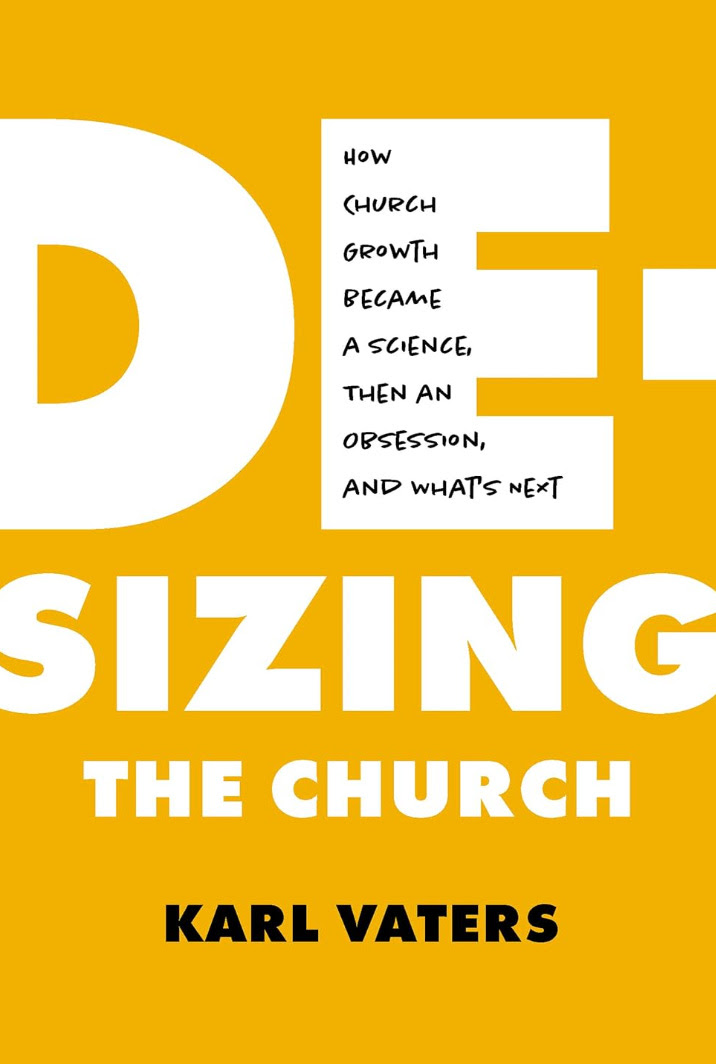
Karl Vaters works hard to be fair minded in giving his accurate assessment of the Church Growth Movement (CGM). He knows it well, and I believe it's own proponents and practitioners would appreciate his descriptions.
Undoubtedly, they will disagree with his disagreements, but he is not backing down. He believes in de-sizing the church. Which does not mean he is a proponent of small churches, but he believes a fundamental issue about the church growth movement has reshaped the church in the last 50 years. We are looking again at his new book, De-Sizing the Church: How Church Growth Became a Science, Then an Obsession, and What’s Next.
 |
In a later chapter, Vaters discusses three phases through which the church has gone through in his life. These resonated with me. The three are revivalism of the 50s-70s, strategizing at the end of the 20th century, and social activism – the rest of this paragraph is all mine – which formed into antagonistic poles from the days of Ronald Reagan on. Progressives sometimes complain that conservatives are overly politicized. But conservatives complained about progressives being involved in political activism well before the days of Ronald Reagan. A new book, which I have not read or seen, argues that Christian nationalism is a reaction to the progressivism of Protestant mainline churches. I believe there is enough blame to go in both directions.
The church growth movement, as practiced, emerged in his “strategizing” phase of the late 20th Century. The author does not say this but the church growth movement is incompatible with the activism phases at work in the church today.
I want to sketch in my own terms briefly where he thinks the church growth movement went sideways. Then we will turn to what he thinks is critical to develop if the church is going to right its course.
To begin with, the fundamental movement sideways was measuring success on the basis of numbers. The bigger the number, the more successful. Furthermore, from the business world discussions of strategy, mission statements, and vision statements entered the church through the church growth movement’s major practitioners. Increasingly, fewer and fewer pastors had theological and biblical expertise and became entrepreneurs and leaders who could fill the seats.
Another fundamental problem that the author finds in the church growth movement was an obsession with methodology, which is the current vogue term for method. Pushing back against old fashioned stale methods led to preoccupation with better methods, which tail began to wag the dog. In other words, get the right method and the right results will follow.
One element of the church growth movement, but by this I mean especially the megachurches that I have been connected to, experienced, read about, or heard about, was what the author calls “toxic positivity.” Negative talk about anything seems to be verboten. Which was one of the reasons when scandals became news that so many in many of these churches did all they could not only to silence the critics but to preserve the reputation of the church. A church that does not recognize the importance of confession and honesty may give way to a positivity that prevents confession when confession is needed.
Of course, we have all recognized that the church growth movement, as it was going sideways, and this sideways action was often done by specific practitioners of the church growth movement’s ideas, was to platform pastors with proven success when success was measured by numbers. So conferences developed at megachurches to reveal to wannabe megachurch pastors how they did the job.
Vaters is aware of the significance of the suburban nature of the church growth movement. He is also aware that the suburban nature of these churches led to ethnocentrism and what I want to call “econo-centrism.” The sideways movement of the church growth movement was planted in suburbs and flourished for only a certain demographic. [SMcK: White folks, middle and upper class. Which is also why that demographic was fertile for a specific kind of political partisanship.]
My experience with pastors in the United States is that the church growth movement, combined as it was with these massive conferences at mostly suburban megachurches, diminished small churches, degraded small church pastors, and led to arrogance on the one side and shame on the other. A number of pastors have told me they quit attending the conferences because they knew in their community the ideas could never be implemented. They were looking for conferences by pastors who pastored people, regardless of the size of the church.
Vaters pleads for “integrity as the new competence.” Integrity, of course, is not really a new version of competence but the alternative, which leads to an entirely different church and culture. He compares the Bigness-Integrity Gap alone these categories.
Bigness: efficiency, leadership, success, hustle, increase, growth, excitement, effectiveness, passion.
Integrity, and here he punts to the fruit of the Spirit, which all OK by me: love, joy, peace, patience, kindness, goodness, faithfulness, gentleness, self-control.
For me, bigness measures numbers with reproducible methods while integrity points at Christoformity. Here’s how Vaters describes integrity:
We need to: 1. Do the right thing, 2. Every time, 3. For a long time, 4. With no agenda.
That’s wise. That’s virtue ethics in a simple formula; his idea of integrity is about character and culture formation.
 |
GUEST POST ~ #ReimagineLEADERSHIP…Less Methods & Meetings; More Counsel & Coaching
Shifting from Leadership to Fatherhood
Glenn Bleakney
In a day and age when the presence of paternal influence is notably lacking, apostolic leaders face an undeniable and urgent need to transcend their conventional roles as mere leaders. Now, more than ever, they must fully embrace their true calling as spiritual fathers, offering guidance, nurturing, and unwavering care that can only be provided by those who embody the essence of a spiritual father.
This generation yearns for a profound and intimate connection, as well as compassionate support that can only be fostered through the presence of spiritual fathers. As spiritual orphans wander, desperately seeking purpose and identity, it becomes imperative for apostolic leaders to wholeheartedly embrace the role of a father, guiding others to experience a deep, personal encounter with God the Father and embracing their true identity as cherished children of the Divine.
Here are ten strategic shifts for apostolic leaders to become influential spiritual fathers, catalyzing transformative change in the lives of those they father.
1. Embodying Christ-Centered Character:
As spiritual fathers, apostolic leaders must embody the very essence of Christ-like character in every facet of their lives. In the same way that Paul implored others to imitate his example as he imitated Christ (1 Corinthians 11:1), leaders who embody the virtues of Christ become living testimonies of His transformative power. Through their embodiment of Christ-like character, these spiritual fathers inspire and influence those under their fatherly care.
2. Cultivating Intimacy with God the Father:
Spiritual fathers must prioritize the cultivation of a deep, intimate relationship with God, serving as models of a life deeply rooted in prayer, worship, and devotion. The letters of the apostle Paul radiate with evidence of his profound intimacy with the Divine, serving as a compelling example for all spiritual fathers. By nurturing their own connection with God, these spiritual fathers create a sacred pathway for others to experience the boundless love of the Father and discover their true identity as cherished children of the Divine.
3. Building Authentic and Meaningful Relationships:
At the very heart of spiritual fatherhood lies the importance of authentic relationships. The letters of Paul reveal his deep yearning for genuine connections with others. Spiritual fathers must invest their time and effort in building authentic relationships, characterized by vulnerability, transparency, and a genuine willingness to journey alongside others through both moments of joy and struggle. By fostering an environment of trust and authenticity, these spiritual fathers create fertile ground for transformative growth in the lives of those under their fatherly guidance.
4. Equipping and Empowering the Next Generation:
Apostolic leaders are called to equip and empower the next generation of leaders, following the example set by Paul with Timothy and Titus. The mentorship of these young leaders beautifully exemplifies this crucial principle. In the same way that Paul entrusted them with responsibilities and encouraged them to fulfill their God-given potential, spiritual fathers invest tirelessly in the development of others, creating a legacy of multiplication that extends far beyond their immediate sphere of influence.
5. Imparting Sound Doctrine and Unyielding Truth:
Paul placed profound emphasis on the importance of imparting sound doctrine in his teachings. Spiritual fathers must ensure that they impart biblical truth and stand unwavering against the waves of false teachings. By grounding their spiritual children in the unchanging Word of God, these spiritual fathers equip them with the discernment needed to distinguish truth from falsehood, establishing a rock-solid foundation for their faith. Sound doctrine becomes an unwavering compass that guides and shapes the lives of those under their spiritual care.
6. Correcting with Love, Grace, and Compassion:
Approaching correction with a heart overflowing with love, grace, and compassion is a vital aspect of spiritual fatherhood. This mirrors the tone of Paul's letters, which were filled with corrective instructions delivered with immense compassion. Humility, discernment, and a genuine desire to witness transformation are crucial components in offering corrective guidance. When rooted in love and grace, correction becomes a catalyst for profound spiritual growth and maturity.
7. Fostering a Culture of Honor and Affirmation:
Apostolic leaders should strive to cultivate a culture of honor within their communities, following Paul's example of honoring and affirming others (Romans 16:1-16). In doing so, spiritual fathers recognize and celebrate the unique gifts and contributions of those under their care. This cultivation of honor creates an environment of mutual respect, encouragement, and empowerment, enabling individuals to thrive and fulfill their God-given potential.
8. Providing Unwavering Spiritual Covering and Protection:
Just as Paul provided spiritual covering and protection to the churches he founded, spiritual fathers offer steadfast guidance, support, and accountability to those entrusted to their care. This covering acts as a shield and guide, enabling spiritual children to navigate challenges and grow in their faith. Spiritual fathers become a source of strength and stability,
9. Modeling Servant Leadership:
Spiritual fathers exemplify the essence of servant leadership, mirroring the selfless nature of Jesus Christ himself. They lead not by exerting authority or seeking personal gain, but by humbly serving and sacrificing for the well-being and growth of those under their care. This sacrificial love and servant-heartedness inspire others to follow their example, creating a culture of servanthood within the community.
10. Nurturing Emotional and Spiritual Healing:
Spiritual fathers understand the importance of addressing emotional and spiritual wounds that hinder growth and wholeness. Just as Paul demonstrated deep care and concern for the emotional well-being of his spiritual children, these spiritual fathers provide a safe space for healing, restoration, and inner transformation. Through compassionate listening, wise counsel, and prayer, they guide individuals towards healing and freedom, enabling them to embrace their true identity in Christ.
Spiritual fathers have the incredible opportunity to leave a lasting legacy by impacting not just one generation, but multiple generations of spiritual children. Through their guidance, wisdom, and mentorship, they have the power to shape the lives of their spiritual children and equip them to become spiritual fathers and mothers themselves. This ripple effect creates a lineage of spiritual growth and transformation that extends beyond their own lifetime, reaching future generations who will carry on the legacy of faith and mentorship. Spiritual fathers truly have the privilege of nurturing and empowering spiritual children who will, in turn, become spiritual parents to the generations that follow.
Enjoy this teaching? Please consider partnering with us. Sign up to become a monthly partner of any amount or give a on-time donation at our website AwakeNations.org/donate
For the Kingdom,
Glenn Bleakney
GUEST POST: Rethink Sanctuary
By Mike Glenn
In ancient times, church buildings were sacred places. If you needed any kind of help, you would go to the sanctuary and someone would give you food or water…whatever you needed. If someone was after you, you could hide inside the church and no one could harm you as long as you were in the church building. A few years ago, several churches resurrected this doctrine to protect illegal immigrants – especially mothers with children– to hide them from authorities who would have arrested and deported them. There is a space where no one in the world can get to you. We call it “sanctuary.”
Our digital age has changed our understanding of space. We can work from anywhere. We can connect from anywhere. We can do anything from anywhere which means anything can be done to us anywhere.
We aren’t safe anymore, anywhere. Not only do we have to worry about hackers stealing our personal and private information, we have to worry about being caught in a social media frenzy through no fault of our own because someone posted a picture or used us in a meme, all without our permission.
We’ve learned to live very guarded lives. We’ve learned to be aware of who’s using a camera on their phone, to be suspicious if anyone is taping our conversations. These days, everyone has a cell phone.
When in public, you have to assume everything is either being recorded or videoed. How many politicians, athletes and corporate executives have been caught in compromising situations because someone had a cell phone? How many adolescents have had their lives ruined because something about them got out on the internet?
The obvious thing is to always be aware that everyone has a phone these days and to act accordingly. But it’s not that easy. In our world of constant surveillance, we’ve lost something. We’ve lost trust in each other. We’re worried about what the other party will do with the information we’ve just given them. Does everything I say to you end up on social media? Will I find myself unknowingly quoted on X, or Instagram, or Tick Tock?
What’s more, we’re beginning to understand no one actually lives the way they say they do in their social media. Imagine that…people lie on social media. The consequences of this constant state of pretending is we’re slowly losing our true selves. Too many of us become our pretend selves, our public selves and we’ve lost our true identities because we can’t find a safe place.
And where is a safe place?
In Corinthians, Paul reminds the early church they are the dwelling place of the Holy Spirit. They are to be careful about the places they go and what they do because wherever they go, they take the Spirit of Christ with them. It also means, we as believers take the sanctuary of Christ with us wherever we go. That means, when people show up in our lives, we do what we can to help. It also means that when someone, anybody, is in our lives, no one can hurt them. They are safe with us. We will give our lives to protect them.
Sadly, churches and Christians have lost the presumption that people are safe with us. The sexual scandals and abuse stories that have broken across the whole spectrum of churches have resulted in people thinking churches and Christians are to be avoided rather than sought out. Christians are seen as self-righteous and judgmental. It breaks my heart to know we have earned these criticisms.
But what if, as Christ-followers, we began to rethink the concept of sanctuary? What if, taking the teaching of Paul seriously, we began to understand that we, as Spirit bearers, are the sanctuaries, the safe places, of our communities and neighborhoods? What if the word got out that people were safe with us? When they were with us, no one would judge them, no one would harm them, and no one would condemn them.
People could come to us and be themselves. We would listen, really listen, not just wait to talk. Our friends would know we’ve heard them and we know them. And we would love them.
No, I’m not talking about a superficial “just love everybody” bumper sticker philosophy. I’m talking about a love strong enough to bear the cross for the beloved. To love a person through all the heartbreak, confusion and darkness that are part of all our lives. To be there, like a lighthouse, that doesn’t move and remind our friends every day, we’re still here. God is still here. We are bearers of His presence.
And the world is safe with us. You can lay your burdens down and sort through them. You can face your pain and not be overwhelmed in the process. Sure, we’ll tell you the truth. True love demands that kind of honesty, but we won’t beat you to death with it. We’ll find a way forward.
More than that, with the help of Christ, we can find a better way. Jesus promised that.
These days, everyone is looking for a safe place. We shouldn’t be that hard to find. Every Christ follower is the dwelling place of the Holy Spirit. Every believer is a safe place. Every Christian is a sanctuary.
© 2024 Scot McKnight, 548 Market Street PMB 72296, San Francisco, CA 94104
The Price America Pays When Christians Throw Stones

Partisan extremism is on the rise in America. Gone are the days where moderates capture votes across party lines. Artificial Intelligence threatens to further push centrists toward the fringes. Christians contribute to divisiveness when they point fingers, something Jesus did only at those passing judgment on “sinners”. When religious leaders brought the woman caught in adultery before Jesus, His response was, “Let any one of you who is without sin be the first to throw a stone”. With “hearts of stone” they reluctantly dropped their stones, but the Lord is seeking those with “undivided hearts”, unwilling to pick up stones, to stem the division in our nation.
Christians already face stiff headwinds, with mere articulation of biblical ethics deemed hate-speak. That’s largely a consequence of lashing out on social media at those with whom we disagreed during the 2016 and 2020 Presidential elections. Our ability to speak into our culture will diminish further if the tone of our responses to anti-Christian rhetoric reflects anger and not the love of Jesus. In 2024, we must choose a “ground attack” of kindness, not an “air assault” of dropping verbal bombs on political “opponents”. However, so far in this election season, that’s not the case.
For Christians, the upcoming Presidential election shouldn’t just be about “Biden 2024” or “Trump 2024” but Acts 20:24. There’s no guarantee your candidate will win, but you and America triumph when Christians die to self and sacrifice on behalf those Jesus died and sacrificed to save. Our nation’s hope lies in churches and Christ-followers electing spiritual imperatives over political allegiance.
The Equal Opportunity Offender
Don is a faithful husband, dedicated dad, loyal employee, and dutiful deacon at his church. On paper and in his own mind, Don checks all the “Christian” boxes. Yet those who know Don well or talk to him for any length of time have heard the questionable comments. A spiritual veneer cracks under the weight of proverbial stones he carries and throws at those who don’t share his conservative political stance on social issues. It’s not a stretch to picture Don escorting the woman caught in adultery into Jesus’ presence – and difficult to imagine him joining the others in dropping their stones. No group is safe with Don – anyone with an “unbiblical” perspective on any topic is fair game. What he fails to realize is that his anger doesn’t qualify as biblical either, and certainly doesn’t mirror the Savior he claims to follow. Don is vocal online and offline, not hesitant to express his views and confront those who disagree. However, he’s less bold in sharing the truth of the Gospel with non-believers and isn’t active in serving the poor to offset the vitriol he spews at society.
The Closet Keyboard Warrior
Mark attends a public university where he’s not at liberty to express his Christ-centered world views in front of students or faculty. The only place he feels comfortable speaking his mind (although behind an avatar and alias) is social media. Free from restraints and filled with youthful exuberance as a new believer, Mark doesn’t realize the damage caused by airing opinions seemingly devoid of Agape love. There are stones thrown in the tone of his posts and comments. Mark comes across as combative to observers, eager to debate politics, parties, and policies with progressives. Escalation is swift if an adversary dares to engage. Stones fly in both directions, never ending with Mark or the other party persuaded or interested in pursuing a relationship. He’s become increasingly aware of the division he’s creating and lack of progress he’s seeing, particularly in this volatile Presidential election year.
The Politically-Inclined Church
Pastor Peterson doesn’t personally toss pebbles at a society hurling boulders toward America’s churches. He doesn’t have to because churchgoers in his pews are doing that dirty work for him. Members are friendly and kind to one another, but not evangelistic or compassionate within the community. Pastor Peterson inadvertently built a culture of “us” (insiders) versus “them” (outsiders) by emphasizing sin in the world without addressing sin within his own congregation. To retain and appease long-time members content with “how it’s always been”, he won’t risk rocking the boat by introducing externally-focused initiatives like personal discipleship, evangelism training, workplace ministry, or local missions beyond holiday “outreach” events. As a result, the church’s mission and messaging misses GC3 (the Great Commandment, Great Commission, and Great Calling), leading members to throw stones rather than using them to build bridges or turn them into bread (to feed the hungry). Their disassociation and distance is contributing to division in his city and our nation.
Those personas may sound extreme, but we carry stones anytime we lose sight of our sinful nature and draw lines in stone rather than circles in sand. Fully grasping God’s mercy in light of our depravity means turning the other cheek as we’re being bombarded with stones rather than picking them up to throw back. The only way Christians will regain our voice in the marketplace of ideas is to earn the right to be heard by loving our “enemies”. Now is the perfect time, during this divisive 2024 election, for unexpected, counterintuitive acts and jaw-dropping gestures of kindness.
The Grieving Christian Longing for Unity
Mary is a mother of three concerned about what the future holds for her children in a United States where the states aren’t united because our churches are divided. She’s active on social media and consumes a balanced diet of conservative and liberal news to gauge what messages are being incessantly fed to her teens. As the 2024 election approaches, Mary is shocked to see avowed Christians more aggressive in backing candidates than campaigning for Jesus. She and her husband have raised their kids in a biblical household as part of a church family, but she fears she’s already losing them. Her college freshman mentioned how judgmental and exclusive Christians are when he came home for Christmas break. Her high school junior has migrated into a new friend group that seems to have little interest in faith. How long until her eighth grader, a video gamer glued to his phone, begins to question what he’s being told are “his parents’ beliefs”? Mary believes the best hope for her kids and America is for Christians to drop their stones and demonstrate the unconditional love of Jesus through radical acts of kindness (prayer, care, and share) with those across the political aisle. If Christians miss another opportunity to replace anger with Agape during this Presidential election cycle, Mary worries the damage may be irreversible.
The Disillusioned Disciple Frustrated with Politics
Stephanie endured “church hurt” and became disconnected from the Christian community. She loves the Lord and would like to reengage with a family of believers who share the values she holds dear – joy, peace, kindness, and compassion. Yet Stephanie isn’t seeing those characteristics in most communications by Christians in the social circles and networks she frequents. She wonders how those who attend church services every week could be so focused on exterior appearances, actions, and words, not recognizing people for who they truly are internally – eternal souls made in God’s image in dire need of a relationship with her Father. It’s that vantage point that fuels the diversity of Stephanie’s relationships, her willingness to serve those antagonistic to Christianity, and her boldness in talking about Jesus with anyone willing to listen. Without compromising her principles, Stephanie navigates the tumultuous environment surrounding the 2024 election by seeking to understand and be understood. Long ago, she made the decision to “drop her stone”, look in the mirror, and take Jesus’ challenge in John 8:7 seriously.
The Community-Minded Pastor Modeling Agape
Pastor Matthews strategically planted his church in an area where diversity is high, incomes are low, and political division runs deep. Launching a year prior to COVID gave ample opportunities for his congregation to practice the compassion he preached. The church is visible in the community, known for its selfless acts of generosity, which led to growth in membership and demands for Pastor Matthews’ time. With greater responsibilities and more to lose came temptations to cling to what he’d worked so hard to build. However, Pastor Matthews is determined not to lose sight of his original vision to love, unite, and serve the community where the Lord placed him. In 2024, that requires combatting the mounting divisiveness over the election, keeping the congregation focused on Kingdom over democracy. He reminds members they only get one vote for President but can cast countless “eternal votes” of kindness for neighbors. Those eternal Kingdom votes have no expiration date, but a vote for President only lasts four years. Pastor Matthews teaches that Jesus conquered division by rolling away a stone so we can’t confront partisan politics by picking up stones.
Join the Drop The Stone movement! #DropMyStone is a national countercultural campaign urging Christians to reject resentment and embrace grace in the months leading up to the 2024 Presidential Election. #DropMyStone seeks to reverse the trajectory of our culture, something no President is able or expected to do. Let’s counter hate with love by praying, caring, and sharing with someone holding an opposing world view. Then, in lieu of lashing out on social media, post those stories with the #DropMyStone hashtag and challenge 5 friends to follow your lead!
Activists like to categorize the opposition by looking at the extremes.

Quick Quote - Source - Jeff Hilles
A Biblical Christian worldview perspective - With every issue, there will always be extreme opinions. I recently responded to a reader who stated that Christian preachers were calling for the execution of gay people.
I am sure one can find extreme views such as this if we look hard enough. However, in most cases, the extremes on both sides of an issue are in the minority. But they do garner media attention and gaslight viewers into believing extreme positions are mainstream. It is important to look to the middle of the bell curve, rather than the vocal extremes when evaluating the popular direction on an issue, especially a divisive one.
From the center of the bell curve, Christians don't hate gay people, they don't want to turn America into a Christofascist state, and most realize there are times when abortion is an appropriate medical need.
Author - Jeff Hilles | BCWorldview.org
GUEST-POST ~ Discipleship: Walking In Eternal Life
Walking in Eternal Life
by Francis Frangipane
God’s end time people will "end time." What I mean is that, as we near the end of the age, we will increasingly learn how to walk in eternal life, abiding above the boundaries, constraints and the pressures of the realm of time. We’ll see what’s coming and either avoid it or announce it, but we won’t be limited by it.
Jesus taught that those who come to Him "have everlasting life" (Jn 3:16). Right now, we have eternal life in our spirits. Yet, how do we access the timeless place of God’s presence? This is a serious question, for we have become more "time conscious" than "God conscious." Schedules, meetings, appointments and deadlines all fuel our anxieties and compel us to live horizontally, instead of vertically in the Presence of God.
The Lord seeks to deliver us from anxiety, but that can only happen if we truly learn to walk in the Holy Spirit. The sad fact is, most Christians fail to spend time with the Holy Spirit. We pray, even calling upon the Lord, but few are they who have cultivated moment by moment openness to the Spirit of God.
"But, when He, the Spirit of truth, comes, He will guide you into all the truth; for He will not speak on His own initiative, but whatever He hears, He will speak; and He will disclose to you what is to come" (John 16:23).
The Holy Spirit "will guide . . . He will speak . . . He will disclose" to us what we otherwise could never know or attain. To guide, speak and reveal are forms of communication. Clearly, the Father sent the Holy Spirit to talk to us.
The Holy Spirit is the Spirit of truth. There are issues in our hearts that the Holy Spirit alone can reveal and remove. Listen to Him, like Christ, He does not come to condemn but to save. His voice is Salvation speaking to us.
Jeremiah said that the heart is deceitful above all things. We cannot objectively know ourselves. Yet the Holy Spirit, who is the Spirit of Truth sees and understands our ways. Trust Him, He cannot be deceived. Indeed, the ancient Greeks used the same word for truth as they did for "reality." Thus, we could accurately say that the Holy Spirit is the "Spirit of Reality." He shows us the reality of our need and the reality of God’s answer. To hear Him is to hear the voice of eternal life.
Jesus lived in union with the Holy Spirit continually. The miracles He accomplished came through the power of the Holy Spirit. Through the Spirit He saw the things the Father was doing; He heard the words the Father was speaking. Every strategy we may come up with pales in comparison to seeing God and doing what God does and hearing God and saying what God says. You see, Jesus lived in the dimension of time, but was not limited by it. His consciousness was always aware of the eternal realm.
Even the urgent news of Lazarus’ illness did not make Jesus move anxiously. As right as it seemed to rush to Lazarus’ aid, Jesus was aware of another reality. He was conscious of the heavenly Father. Because He knew that the Father was about to raise Lazarus from the dead, He lived without hand-wringing or being driven by anxious thoughts or pressures.
Oh how we need to walk in the Spirit today. In every situation, we would consciously be aware of God's involvement in our lives!
"For My thoughts are not your thoughts, neither are your ways My ways," declares the Lord. "For as the heavens are higher than the earth, so are My ways higher than your ways, and My thoughts than your thoughts" (Isaiah 55:8-9).
God has a system of thoughts and ways that are totally on another plane, yet He invites us to abide with Him!
Beloved, we are not mere human beings. We each are a temple for the Holy Spirit, but we must cultivate a listening heart if we will do the things that God is doing. A Christian is not just someone living out a natural life, hoping that God will bless him. No, God has more for us than that. Jesus set the standard, and He’s given us the Holy Spirit so we can follow Him.
Spirit Filled?
When we are born again, we begin a journey with the Holy Spirit. The Spirit gives us gifts to help us grow; He baptizes us in power to increase our effectiveness. All of this is to lead us until we are actually filled with the Holy Spirit, where we think and act like Jesus.
Many of us think we are already filled with the Spirit, but we are not. We have three quarts of self and one quart of the Holy Spirit, and we think we have a gallon of God. There is still too much self ruling in our hearts. In America, some pastors identify themselves as being Spirit filled and say they pastor Spirit-filled churches. To be perfectly candid, I have never attended a church that is truly Spirit filled. In the Book of Acts, we see a picture of a Spirit-filled church. The leaders met daily for prayer, and on the way to prayer, their shadows healed the sick! Their offerings went to feed the poor. Out of their sense of love and community, they held all things in common. In that atmosphere, the church grew exponentially.
I know some are thinking, "My church is getting close to this example." Oh, I forgot to mention, in a Spirit filled church, if you lied, you died (see Acts).
You see, let’s not accept that we are further along spiritually than we are. God desires to take us further, deeper into eternal life. Having a spiritual gift doesn’t mean that you are filled with the Holy Spirit; being born again does not mean you are also Spirit filled. I have never met a truly spiritually mature person who was anxious; no one who is nervous about time can truly be led by the Holy Spirit.
Where Do We Go from Here?
In our quest to walk in eternal life, we must allow the Holy Spirit to excavate our hearts of self. If we want to tune into the God channel we must tune out the "self channel," where the anxieties, fears and sins exist.
I want a heart that can hear God; I want perception that can see God. We are too much like the world. How do we break this? Spend time with the Holy Spirit. Ask Him to talk to your heart and then write down what you feel He is saying. If we want more of God, we must cultivate the awareness of His Presence, and especially listen for His voice.
We must also take faith and believe that the Spirit is here to help. Zechariah 4:6 teaches us that it’s not by our might or power, but it is by the Spirit of the Lord that we succeed. Acts 2:17 tells us that in the last days God seeks to pour out His Spirit upon all flesh. I love the words "pour out." We must stop thinking "thimble" and think Niagara Falls!
It’s time to step out of the box called "time," and live in the Spirit. I’m not suggesting that you become unreliable or are late for your appointments, but that you give yourself to learning how to hear God’s voice and how to live in His presence. If you are one of God’s end-time elect, then it's time to rise above the pressures of time and walk in the eternal life of God.
Holiness, Truth and the Presence of God
This is the first book ever written by Pastor Francis. It came after three years of studying and repeatedly reading the Gospels. The thrust of these messages is geared towards those who desire the holy, powerful life of Jesus Christ. It is a penetrating study of the human heart and how God prepares it for His glory.
Book - $9.60 (Retail $12.00)
Ebook - $9.60 (Retail $12.00)
Audio Book on CD $12.00 (Retail 14.75)
Audio book on MP3 $6.00 (Retail $12.00)
Companion Teaching - CD Series $26.25 (Retail $35.00)
Companion Teaching - MP3 Series $13.13 (Retail $17.50)
~ ~ ~ ~ ~ ~ ~ ~ ~ ~ ~ ~ ~ ~Disciples of the Cross
- audio series
As we learn to share in Christ’s sufferings, we join a society of redeemers who walk in God-given abundance.
Message titles:
Fellowship of His Sufferings
Wimps or Warriors
Disciples of the Cross
Conquering Conflict Through Character
CD Audio Series - $15.00 (Retail $20.00)
MP3 Audio Series Download - $7.50 (Retail $10.00)~ ~ ~ ~ ~ ~ ~ ~ ~ ~ ~ ~ ~ ~
In Christ's Image Training
New self-paced online format.
In Christ’s Image Training is an international online course developed by Francis Frangipane, designed to take Christians at all levels and lead them into a deeper understanding of what it means to be like Christ.
Learn more at www.icitc.org.
Training also available in Spanish / Español
~ ~ ~ ~ ~ ~ ~ ~ ~ ~ ~ ~ ~ ~Visit Arrow Bookstore to order these and
other resources by Pastor Francis~ ~ ~ ~ ~ ~ ~ ~ ~ ~ ~ ~ ~ ~
Receive daily posts from Francis:
Follow Francis on Instagram
______________________
You can support Advancing Church Ministries at www.frangipane.org/donate
______________________
Comments and Questions
eword@frangipane.org
______________________
A service of Frangipane Ministries, Inc.
Copyright (c) 2024
All rights reserved.
Unless otherwise stated, all Scripture quotations were
taken from the NASB.
GUEST POST ~ Thom Rainer
Your Church Must Deal With Rapid Change
“Our team has conducted hundreds of church consultations. I did my first consultation in 1988. We have a plethora of anecdotal data and church member interviews where we see that Baby Boomers are often the most resistant to change. Indeed, in some of the churches, the Baby Boomer members decided to close the church rather than infringe upon their personal preferences (Church Answers Research).
“Many churches will likely have new opportunities to make needed changes for greater congregational health as the Baby Boomers fade from the scene.
“Innovation and change in churches will improve.”
https://churchgrowthmagazine.com/seven-ways-your-church-must-deal-with-rapid-change/
#ReimagineFutureChurch
GUEST POST ~ Is This Your New Normaal?
Absolute Surrender; Undistracted Devotion
by Mike Higgs
We heard a startling and sobering statistic the other day. According to the latest Gallop poll, 81 percent of Americans say they believe in God, which is the lowest percentage since Gallop started asking the question in 1944. Other polls tell us that around 63% actually identify as Christians. These percentages are not surprising to those of us who are observers of culture shifts in our country. But a statistic used by author John Mark Comer in a recent podcast highlighted what he calls "the chasm we have in the wider culture" between identifying as a Christian and actually living like one. He says, "Any attempt to actually measure how many Americans are practicing the way of Jesus, like discipling under or apprenticing under Jesus, most estimates come in right around 4%." Yikes!
This statistic is sobering because we live in sobering times. Hopefully no explanation of that is necessary. For me, there is no 59% gap between what I confess with my mouth and how I live my life. But there remains a gap. And I am trying to minimize if not eliminate it, through what the author Andrew Murray calls "absolute surrender." For me, absolute surrender has meant developing my own" rule of life," so to speak, then praying regularly and desperately that I might life in accord with this rule. I put this together a few years ago, and call it My New Normal. It resides in my journal, where I reflect on it and pray into it several times a week.
My New Normal:
• Jesus has not made a difference in my life; rather, He is my life. I have died and my life is hidden with Christ in God. I am a new creation in Christ.
• I have not accepted Christ into my life; rather, I have surrendered my life to Him, absolutely, unequivocally, and unconditionally. My life is not my own. I have been bought with a price.
• While I have set apart a daily devotional time, my life is to be a 24/7/365 devotional time. There is no sacred/secular division or distinction. I seek to Practice His Presence continually, in unbroken fellowship and prayer.
• While Sunday mornings and other experiences of corporate singing, prayer and teaching are an expression of my worship, the offering of my body as a living sacrifice (Rom. 12:2) is my continual act of worship.
• I have no rights.
• I will be unoffendable.
• I will forgive always and without exception.
• I will always consider all others as more important than myself.
• I will resist any measure of conformity to any pattern of this world, and be transformed by the renewing of my mind.
• I will be all in, all the time, all the days of my life.
• I will love my wife as Christ loved the church and gave Himself up for her.
• I will give the rest of my days, with my wife, to awaken the church, equip the willing, engage the culture, disciple the nations, and otherwise bear witness of Christ. Together, we will help people discover their true identity, purpose and belonging through Christ.
• Following the example of the Lord’s Prayer – “Your kingdom come, Your will be done on earth as it is in heaven” – we will seek spiritual transformation in our community, through our prayers and our service.
I have seen some significant shrinking of the gap in my own life over the past few years, and I think (hope) my wife would concur. But I have found there is an obstacle to further progress: distraction. And I am a master of distraction. One of my favorite authors, Francis Frangipane, says, "It is time to enter the place of undistracted devotion." More on Undistracted Devotion in the next newsletter.
|
GUEST POST: The Power of Stories: Learning from the Past to Shape Our Future
{ Note: Read from a ministry, rather than a busdiness, perspective... } The Power of Stories: Learning from the Past to Shape Our Future
In the grand tapestry of human existence, stories serve as the threads that weave together the fabric of our collective experience. From ancient myths passed down through generations to modern-day narratives unfolding in real-time, stories have always been the cornerstone of how we make sense of the world around us. As a business transformation strategist and consultant specializing in project management, portfolio management, and program management, I have come to appreciate the profound impact that stories have on shaping our understanding of the past and guiding us towards a better future.
Stories have a unique ability to transcend time and space, connecting us to our ancestors and offering insights into their triumphs, struggles, and triumphs. Whether it's the epic tales of heroes and heroines overcoming adversity or the intimate anecdotes shared around a family dinner tableIn the grand tapestry of human existence, stories serve as the threads that weave together the fabric of our collective experience. From ancient myths passed down through generations to modern-day narratives unfolding in real-time, stories have always been the cornerstone of how we make sense of the world around us. As a business transformation strategist and consultant specializing in project management, portfolio management, and program management, I have come to appreciate the profound impact that stories have on shaping our understanding of the past and guiding us towards a better future.
Stories have a unique ability to transcend time and space, connecting us to our ancestors and offering insights into their triumphs, struggles, and triumphs. Whether it's the epic tales of heroes and heroines overcoming adversity or the intimate anecdotes shared around a family dinner table, stories serve as windows into the human condition, revealing our shared humanity and universal truths.
At the heart of every great story lies a lesson—a nugget of wisdom that offers guidance and inspiration for navigating life's complexities. As business leaders and decision-makers, we can draw invaluable insights from the stories of those who have come before us, learning from their successes, failures, and everything in between. By embracing the lessons of the past, we can chart a course towards a brighter and more prosperous future.
But stories are more than just vessels for conveying information—they are catalysts for transformation. When we hear a compelling story that resonates with our values and beliefs, it has the power to ignite our imagination, spark our creativity, and compel us to take action. Whether it's a tale of innovation and entrepreneurship or a narrative of resilience and perseverance, stories have the power to inspire us to reach for greatness and strive for excellence in all that we do.
By harnessing the power of storytelling, leaders can engage their teams, align their vision, and mobilize collective action towards a common goal. Whether it's communicating a new strategy, rallying support for a bold initiative, or inspiring a shared sense of purpose, stories have the power to bring people together and propel organizations towards success.
But perhaps most importantly, stories remind us of our humanity—that we are all connected by a shared narrative, bound by common hopes, dreams, and aspirations. In a world increasingly characterized by division and discord, stories have the power to bridge the gaps that separate us, fostering empathy, understanding, and compassion. By sharing our stories with one another, we can break down barriers, build bridges, and create a more inclusive and equitable world for future generations.
In conclusion, stories are not just a means of entertainment or information—they are the essence of who we are as human beings., stories serve as windows into the human condition, revealing our shared humanity and universal truths.
GUEST-POST: City Saturation = Prayer Saturation x Christ Saturation
1. Above all, you need to start by saturating your own life with more of who Christ is today.
To enlarge and enrich your own vision of and passion for the majesty and supremacy of God’s Son today so that, in turn, you can share this with others, go to ChristNow.com. Scroll down to “Exalting Jesus: A 21-Day Video Journey Into More of Christ” and click on the button—and get ready to be saturated with much more of our Lord Jesus Christ!
2. Next, try to saturate fellow believers with more of the wonders of Jesus that you have uncovered.
Once you’ve taken the 21-Day Journey yourself, form a small group in your church to go on the Journey together, viewing three video clips per one-hour session for a total of seven sessions.
Within each session, take time between the three video clips to discuss what kind of fresh insights you’ve gained in each video clip about the glory of who Jesus is today.
End each session in a time of worship and prayer. Pray especially for a Christ-saturation of your entire church and for many there to wake up to the fullness of the greatness and glory of Jesus the way you have begun to do so through the 21-Day Video Journey.
3. Form a Christ Awakening Servant Team (CAST) inside your church to transform your church.
A CAST can have as few as four to five members who want to help saturate their church with more of the person, presence, power, and purposes of our reigning Redeemer today. The CAST strategy is easy to implement. Over time, it will bring a whole new spiritual dynamic into the life of your congregation.
To get started, go to ChristNow.com. Scroll down to the panel about the Nationwide Campaign and click on the button that says, “Learn More.” Then, scroll down to the panel about the CAST and click on that button to get all the help you need to form this group and begin to serve the Body of Christ in an unprecedented way.
4. Subscribe for free to the Christ Now Resources Catalog so you can keep growing in your life in Christ.
5. Pastors and other Christian leaders should definitely consider drawing on the in-depth teaching found in “The Christ Institutes Video Training Series.“
Over the past 50 years, David Bryant has been defined by many as a “messenger of hope” and a “Christ proclaimer” to the Church throughout the world. Formerly a minister-at-large with the InterVarsity Christian Fellowship, president of Concerts of Prayer International (COPI), and chairman of America’s National Prayer Committee, David now provides leadership to ChristNow.com and Proclaim Hope!, whose mission is to foster and serve Christ Awakening movements. Download his widely read ebooks at ChristNow.com. Enjoy hundreds of podcast episodes. Watch his weekly vlogs at David Bryant REPORTS. Meet with David through Zoom or in-person events through David Bryant LIVE!
Church Growth: The Road Less Traveled
|
|||
|
|||
|
My 10 Commandments for God
Phil Miglioratti * Reimagine.Network
Context: I firmly believe in the God of Genesis 1:1 and the original 10 Commandments. I do not believe the Creator necessitates ten suggestions from me or anyone else. I do not believe a list like this provides God with new ideas. My sole (and soul) purpose is to invite readers, especiall those who are skeptical about God, to consdier these assertions as a way to reimagine God... and faith.
If you can, read this list and agree with each of these “commandments” you are close to faith n the God I find in the Bible.
You are not searching for a religion. You are seeking, even yearning for, a relationship with the One walks with us along the way of truth that breathes life into our bodies-souls-and-spirits.
No matter what adjective you used to describe yourself (religious, political, philosophical; theist or atheist), this ancient wisdom may be a good place to (re)start:
You must trust the Lord
and not your own judgment.
Always let him lead you,
and he will clear the road
for you to follow.
Don't ever think that you
are wise enough,
but respect the Lord
and stay away from evil.
Proverbs 3:5-7
Jesus was right when he told us to "Seek God first ... live righteously ... and God will give you everything you need" (Matthew 6:33).
God is real and has revealed True Self - "Without faith no one can please God. Anyone who comes to God (wanting truth, hope, peace, love, forgiveness, eternal life) must believe that God is real and that he rewards those who truly want to find him." (Hebrews 11:6) - This God I want to believe in wants to be found . . .
“Usually a host serves the best wine first.
‘Then when everyone is full and doesn’t care,
he brings out the less expensive wines.
But you have kept the best until now!”
John 2:10 NLT
My way is the best course.
Other paths claim to bring peace, but wind up being dead-end roads.
Evil trails look inviting, but their promised ecstasy turns into agony.
Believers nestling near My heart experience inexplicable tranquility.
My wonderworks change dull days into delightful days.
To access Holiness Highway, you must deliberately exit Evil Track.
Genuine belief is more than knowing My Word—it’s doing as I say.
Authentic love for Me is shown only one way—obedience to My orders.
Obey Me, and receive a special gift—I will make Myself real to you.
I am the Wonderful Counselor—follow My guidance, and rest easy.
My truth is the best creed.
Other teachings seem reasonable, but are deceptive and deadly.
My omnipotence can handle anything—no problem is too hard for Me.
My glory can be glimpsed in creation’s beauty and grandeur.
My omniscience can see right through you—I can read your heart.
I know your secrets, noble intentions and sincere desire to honor Me.
Life’s highest truth is this—get to know Jesus Christ and get to know God.
I am the Everlasting Father—focus on My glory, and know reality.
My life is the best celebration.
Other lifestyles advertise pleasure, but are dangerous risks.
The evil one steals enthusiasm, kills joy, and destroys influence.
My vintage wine gets sweeter every day—nothing else can compare.
It did not come cheap—I trod the winepress alone on Skull Hill.
I paid for you with My blood—I redeemed you at a very high cost.
Satan gives you the best he has to offer now, and then brings out his worst.
I give you good things now, but I am saving the best for last.
The Lamb’s wedding feast will be a celebration that will never end.
I am the Prince of Peace—have faith in My government, and rejoice.
© By Johnny R. Almond
Gentle Whispers from Eternity
Book available on www.Amazon.com
If your life honors the name of Jesus, he will honor you.
2 Thessalonians 1:12 THE MESSAGE
I honor those who honor Me—set your heart on My reciprocal honor.
Live gracefully—relate kindly to everyone.
Behind the scenes, all people around you fight a hard battle—be kind.
Living the Christian life is humanly impossible—be humble.
Count on My power to enable you to do what I ask—be strong.
Follow My example by living a life of love—be compassionate.
Guard against arrogance—honor Me by relying on My power.
Above all else, love.
Think calmly—respond peacefully in all situations.
Let Me know what is on your mind, what is troubling you—be tranquil.
Believe the future is as bright as My promises—be confident.
Anticipate the perfect tomorrow I have planned—be optimistic.
Climb into My grace hammock and be at ease in My care—be relaxed.
Guard against angst—honor Me by trusting My promises.
Whatever happens, look forward.
Serve faithfully—reach out to the lost with heaven’s Good News.
Share the Gospel with everyone who will listen—be concerned.
Remind unbelieving sinners there is hell to pay—be convinced.
Turn your good intentions into noble initiatives—be committed.
Invite others to join you on the journey to glory—be cordial.
Guard against apathy—honor Me by offering My pardon.
In My service, be loyal.
Endure unflinchingly—run perseveringly until the finish line.
When tempted to give up the fight, look again at the cross—be brave.
When you suffer for My sake, keep walking in My steps—be faithful.
When you feel like I have forgotten you, recall My love—be grateful.
When you wonder if it is worth the effort, struggle on—be tenacious.
Guard against apostasy—honor Me by copying My pattern.
By My grace, last.
© By Pastor Johnny R. Almond
Day 349, Gentle Whispers from Eternity
Book available at www.Amazon.com



 LIKE
 COMMENT
 RESTACK