All Posts (1583)
Sort by
Hello everyone,
I have information about spiritual warfare on my website:
http://www.valentinabestmusic.net/spiritual-warfare-daily.html
including very informative and educational material about destroying witchcraft and dangers of the occult.
Please read gospel tracts entitled: "Exposing And Destroying Witchcraft!" "Dangers Of The Occult: Exposed!" and "You Can Be Set Free!" at: http://valentinabestmusic.net/read-free-ebooks-online.html
I also have many other inspirational and motivational tracts on my websites at:
http://www.godzangelmusic.com & http://www.valentinabestmusic.net
Please recommend this material to all your friends:
http://valentinabestmusic.net/recommend-website.html
God bless you all!
Recently I asked a man and his wife, "What is your Jesus story?"
The husband answered, "What?"
I asked, "How did you come into relationship with Jesus?"
As he looked at his wife, she said, "He asked you."
He stuttered through a few "Ah, um, well, I, uh ..." and then said, "I've always been in church."
When I asked the wife, she answered, "I was nine years old, and a mean old aunt took me to Sunday School."
I thought to myself, "Ah, the beginning of a good Jesus story."
She continued, "The next week I was baptized."
Arggggg! How can you have a Jesus story and not mention Jesus? Is mentioning Jesus "tabu" even in Christian circles? What are they teaching in church?
After this, I was meeting with a friend talking about how he came to know Jesus. His answer to me was the same as above: "I was brought up in the church." His story was different in that he said, "If my parents didn't take me, I went with my grandma." I pressed a bit further and found he did have a Jesus story, but didn't know how to explain it.
As I was talking with him, I formulated the following Jesus Story Pattern (JSP) for writing out or talking through a Jesus story.
1. Before - What your life was like before you came to know Jesus? There are two sub-parts: a) Life - How did you grow up? Were you part of a church or not? b) Problem - What was it that convinced you to seek after God? The problem is not to be detailed, but generalized.
2. How - It is in this section that you mention Jesus. How did you come to know Jesus? There are three sub-parts: a) Talked to - How did you hear about the need for Jesus? Someone most likely "talked to" you about your need for Jesus. b) Believed/acted on - How did you respond to what was said? What did you do as you thought through what you heard about Jesus? and c) Prayed - This is where you talked to Jesus about your condition and your need of Him.
3. After - How have things gone since? This has two sub-parts: a) Life - What happened immediately after? Are things going good or bad? What is it you are certain of since you gave Jesus His rightful place in your life? and b) Verse - Is there a verse which had or has significance for you after you started following Jesus?
A few days later I was talking with a gal who had visited the Lighthouse Airman Center on Eglin. As I introduced myself and talked about the Center, she asked if I was a Chaplain. I said, "No, but if you need to talk, you can talk with me; and if you'd rather talk with a Chaplain, I can get you in touch with one."
She wasn't disappointed, but seemed rather excited. "I'd really like to know about how to become a Chaplain. I've always wanted to be a Chaplain. Members of my family are preachers and evangelists, and I thought I'd like to become a Chaplain."
"So, are you a Christian?" I asked.
"Yes." She was emphatic.
I asked, "How did you come to know Jesus? Tell me your Jesus story."
"Um, I don't think I have one. How would I know?"
As I talked with her, asking questions of her background, it came clear to me that she did indeed have a Jesus story; she just didn't know to express it and hadn't been taught about the importance of her story about Jesus. As we talked, I wrote the above JSP on a napkin talking about each part so she could clearly know and be able to express to others how she had come to know Jesus.
Although I will talk to lots of people about this JSP, my plan is to present it to our Tuesday Bible study group during the September Discipleship Tuesday. My prayer is that as they insert their story into the JSP, they will more clearly know their own story, be better able to tell their story to others and have a tool to pass on to their disciples.
“I never thought we would be world champions. We have to be humble.”
(Cristiano Ronaldo, Portugal forward, after his team’s 2-2 draw with the U.S. in the World Cup)
The 2014 FIFA World Cup has captured the attention of millions around the world—putting work on hold, mesmerizing fans, raising enthusiasm to a fever pitch,and moving many to gamble on hopeful outcomes. Yesterday, despite chants of “USA…USA…” America’s premier soccer team experienced a heartbreaking loss to Belgium.
Is this sports phenomenon merely a diversion from workplace drudgery, providing temporary relief from daily responsibilities? Is it an extension of national pride,a patriotic contest for supposed superiority? Or does it serve as a substitutionary contest, giving spectators an opportunity to imagine they are the ones making the goals (or saving them)?
There seems to be a human need to win vicariously, satisfied by victories of one’s favorite team. Life is difficult (as Scott Peck observed). We don’t always win life’s battles,no matter how hard we fight. So it’s good to celebrate our team’s success when they win a game; in the process we feel better for a while. Somehow we’re encouraged to face life’s daily frustrations energized by a small dose of exhilaration.
I wonder if there might be something more profound going on in this global frenzy over soccer. Could there actually be (to use Jurgen Moltmann’s term) a theology of play? If so, what might it imply? Is there an innate, even God-given, human need for lightheartedness and game playing? Does the agony of defeat drive us to search for more meaningful and valuable enterprises?
When the World Cup contest is over, and the final winner is announced, what difference will it make in our daily life? As exciting as sports victories are, spiritual victories are more crucial—and lasting. When we fully rely on God to enable us to win over worry, fear, greed, and other sins, triumphing is a real cause for wholehearted celebration.
“The God of peace will soon crush Satan under your feet. Thank God! He gives us victory over sin and death through our Lord Jesus Christ.” (Romans 16:20; 1 Corinthians 15:57 NLT)
Johnny R. Almond
Author, Gentle Whispers from Eternity—Scripture Personalized
http://GentleWhispersFromEternity-ScripturePersonalized.com/
Sunday, June 29
Spattered throughout scripture is the idea that, on this earth in this life, we are merely sojourners.
Travelers just passing though.
Even “aliens and strangers” moving about on this God-breathed world (1 Peter 2:11).
Or, put a little more bluntly by Jesus, we are well cared for “leaves of grass,” here today then withered and tossed on the fire tomorrow (Matthew 6:30).
The point being made is one that we often don’t truly get or even care about until, well, the end is nearer than we’d like.
That point is simply this: life is transient and temporal.
Every one of us will die. Some sooner than others. And all by various means and ways.
Because this reality has been thrust brusquely upon our family in the past few days, I’ve been contemplating, among other things, the idea of “hospice” as we’ve been practicing it.
The literal definition of hospice is intriguing:
hos•pice (hŏs-pĭs)
n.
1. A shelter or lodging for travelers, pilgrims, foundlings, or the destitute, especially one maintained by a monastic order.
2. A program that provides palliative care and attends to the emotional and spiritual needs of terminally ill patients at an inpatient facility or at the patient's home.
[French, from Old French, from Latin hospitium, hospitality, from hospes, hospit-, host; see ghos-ti- in Indo-European roots.]
(The American Heritage® Dictionary of the English Language, Fourth Edition)
When the two proffered meanings are blended, as I believe they should be, the truth that surfaces is that, in a sense, we are all engaged in hospice, both as givers and receivers of care.
We are all earth-sojourners seeking hospice -- shelter, care, lodging -- day in and day out.
* * *
My mother-in-law, Ann Laub, a vital and head-strong woman that I’ve known only a few years, went to the hospital some days ago. Her complaint was an ankle gone awry. At 81 going on 82, it doesn’t take much to send a body into a deep hurt.
Sparing some of the finer details, she came out of the hospital after a couple of weeks straight into home hospice.
As you can guess, many other factors were at play. But still, it took all of us varying degrees of time and depth of pondering to move past the “But it was only a sprained ankle!” to the hard reality that it is much more.
I think we are all still working it out in our heads and hearts. But the result is the same no matter what.
The weight of life is bearing down. And it hurts.
Now, three strong, lovely daughters (Cynthia, Debra, BethAnn), working as ministering angels, attend to Ann’s needs in rotating shifts. They are variegated images of their strong, lovely mother.
Walt, husband and father, attends also, sorting through all that’s happened and happening, working hard to make sense of it all while being there by her side. His is a difficult and arduous task despite appearances to the contrary. My heart breaks for him, and them.
Others of us, connected by blood or marriage, are here as best we can be. Alternately stepping in to help or moving out of the way as needed. It’s a kind of a dance with awkward steps we’re all trying to learn meaning toes get stepped on at times.
There is nothing about this that is not hard. And for each, it’s hard in different ways only each can understand and parse. None can tell another how to feel, how to think, how to go through this.
After all, a family is a unit made up of different individuals. Even shared experiences are colored and made infinitely personal in the hearts and minds and memories of each one.
That’s the way of life.
And life, as death, can be messy. All the hurts and hopes, mistakes and successes, good decisions and bad, trials and joys of life still crowd in at the end, demanding a place, seeking to be heard, wanting to be acknowledged, or perhaps forgotten.
As in life, at death tempers flare, love surges up, tears fall, hugs are given or shunned, misunderstandings erupt, and memory recalls lighter, brighter, happier times as laughter inexplicably bubbles up out of deep sorrow.
Amazingly, mysteriously, joy finds a way.
This is the awkward dance of life.
Today the dance has taken a turn as Ann’s breathing seems to be fading. Everyone has gathered.
* * *
After a few bumpy turns on the dance floor, things settle into a whispered vigil.
Dad works on his crossword from the morning paper. One washes dishes. Another updates the notes for the nurses. And someone else cleans. All are working hard in their own way.
Besides the labored breathing, there are the random exclamations. Ann is nearly simultaneously lucid and not. Deciphering her meanings is as complex as working out a difficult crossword.
How long this will go on is anyone’s guess. Right now, just about everything’s a guess.
Much of life is a guess. But there are certainties. God’s love and grace is assured to those who are his children.
Jesus taught that in giving shelter, clothing, a drink of water -- hospice -- to another fellow sojourner, it was as if we gave it to him (Matthew 25:35-45).
Service rendered in love to the helpless is a miracle of grace. Especially when the helpless and those serving are a little head-strong.
* * *
Jesus comforted his disciples assuring them of their place in his kingdom and in heaven. “Do not let your hearts be troubled. Trust in God; trust also in me,” he told them, and then explained that he was going ahead to make preparations.
“Where is it you are going?” they asked.
He told them they knew the place and pointed them in the right direction saying, “I am the way and the truth and the life. No one comes to the Father except through me” (John 14:1-11).
Paul writes in Romans that those who “confess with your mouth, ‘Jesus is Lord,’ and believe in your heart that God raised him from the dead, you will be saved” (Romans 10:4-14).
But what if, some may fret, I’m coming to all of this late, near the end? Not to worry. Again, schooling his disciples, Jesus said, “But many who are first will be last, and many who are last will be first” (Matthew 19:25-30).
Spiritual hospice is always available to the living, even when near the end of our journey.
Ann is ready even though some may not be.
* * *
In addition to ministering to Ann’s needs, the daughters also managed to prepare a simple supper. In response to an earlier more lucid request, a dear relative brought the key ingredient for crab cakes.
The freezer was raided for some side veggies. Sundry leftover sweets were gathered from the refrigerator. And the table was beautifully prepared with places for everyone but Ann.
Then the traveling RN, Joe Evans, came.
One of many of the care workers available at a moment’s notice, Joe was a wonder. Calmly, with humor and sweetness, he spoke softly, answering myriad questions while at the same time tending to Ann’s needs.
Every concern was gently and thoroughly addressed. Every person was acknowledged. Every expended effort by the family was praised.
Finally, after repacking his bag, he asked to pray with the family around Ann’s bed. Grateful, we circled, held hands, and were humbled as Joe prayed with sincerity, and tears.
Joe understood that this was hard.
* * *
Something I’ve learned about the concept of family is that the meaning and the members shift over time for many reasons, some joyful and some painful.
Death, romance, marriage, birth, adoption, divorce, re-marriage, betrayal, distance, friendships, feuds, and more all impact the family unit. Add to that the connections and severings between and among extended family units.
It can get very complicated at times.
What I’ve also learned is that families are resilient, in their parts and on the whole, and there is always room for new members. It always takes a bit of adjustment on everyone’s part, but the love always grows to embrace the new additions, no matter how they come in or how long they stay. It continues even when some turn their backs and walk away.
Which leads to the most important thing I can say about my family: In all its permutations, I love my family. Whether immediate or extended, here or departed, each part and each person is special and valuable and dear to me. I have been blessed with a great family and a great heritage.
This most recent permutation of my family, where I have been adopted by virtue of marriage to BethAnn, has been and is a joy. The Laubs have taken me in and extended living hospice to me. They have made me one of them and because of that I am in awe.
Ann has been a key part of that acceptance.
One of the best Christmas gifts I’ve ever received is an Emily Dickinson doll. Ann had noticed a joking reference I’d made to the doll on Facebook. Seeing the doll when I opened the box cracked me up, which was exactly the reaction she was going for. Of course, later, so Emily wouldn’t be lonely, she got me the Will Shakespeare doll. Both are proudly displayed in our home.
* * *
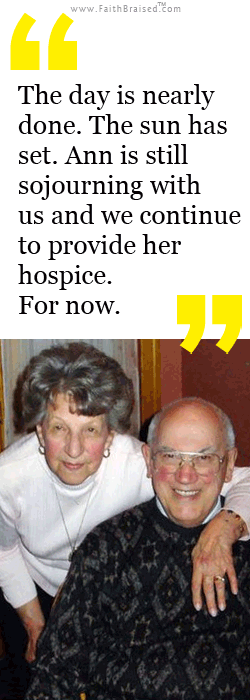
The day is nearly done. The sun has set. Ann is still sojourning with us and we continue to provide her hospice. We will miss her, but in this experience we will gain a new appreciation of her and of each other.
And this comes to mind:
“I declare to you, brothers, that flesh and blood cannot inherit the kingdom of God, nor does the perishable inherit the imperishable. Listen, I tell you a mystery: We will not all sleep, but we will all be changed-- in a flash, in the twinkling of an eye, at the last trumpet. For the trumpet will sound, the dead will be raised imperishable, and we will be changed. For the perishable must clothe itself with the imperishable, and the mortal with immortality. When the perishable has been clothed with the imperishable, and the mortal with immortality, then the saying that is written will come true:
'Death has been swallowed up in victory. Where, O death, is your victory? Where, O death, is your sting?' The sting of death is sin, and the power of sin is the law. But thanks be to God! He gives us the victory through our Lord Jesus Christ. Therefore, my dear brothers, stand firm. Let nothing move you. Always give yourselves fully to the work of the Lord, because you know that your labor in the Lord is not in vain” (1 Corinthians 15:50-58).
Hospice is the work of the Lord.
* * *
We’re all tired. The daughters are exhausted. Tonight we’ll sleep, maybe.
Tomorrow?
“[D]o not worry about tomorrow, for tomorrow will worry about itself. Each day has enough trouble of its own” (Matthew 6:34).
Yes, today was enough for today.
=======
 What are your experiences with losing a loved one or providing hospice? What helped? What didn't help? Please share your thoughts in the comments.
Originally posted at www.FaithBraised.com.
Recently a friend and I were discussing some of the hot-button issues in our country today. We mentioned such things as gay marriage, abortion, healthcare, and income inequality, to name a few.
We all have our opinions on such things, of course. As believers, our opinions hopefully have been shaped by God’s principles and wisdom found in the Scriptures. In a world filled with moral relativism, we desperately need the Word of God as a plumb line to reveals our off-kilter values and behaviors (Amos 7:7-8).
But while discussing these things with my friend, I saw that being right on the issues is only half the battle. If are beliefs are right, but our attitudes are wrong, no one will be impacted in a positive way. Instead of having a platform to transform our society, we will either be ignored or ridiculed—and we’ll have only ourselves to blame.
So, while some people are too timid to address the hot-button issues at all, others undercut their message because of a calloused, unloving attitude toward their audience. They may be “speaking the truth,” but they are failing to do so in love (Ephesians 4:15).
No wonder we’ve lost our audience and become largely irrelevant in the debates over the pressing social issues of our day. How sad.
The Message and the Heart
As I’ve pondered this unfortunate state of affairs, I’ve concluded that two problems must be remedied. First, our message must regain its clarity. The apostle Paul warned, “If the trumpet makes an uncertain sound, who will prepare for battle?” (1 Corinthians 14:8) Where are the pulpits and publications today that are trumpeting a clear message from God instead of just spiritual mumbo jumbo? Too often, we sound more like politicians than preachers, coming down on each side of every issue. No one will be moved to action by that kind of indistinct trumpet sound.
But as important as it is for our message to regain laser-like clarity, the other problem is perhaps even more urgent: We must speak our message with the heart and “face” of Jesus. This gets back to the attitude and spirit in which our message is delivered. Correct words become hollow and impotent unless spoken with a correct heart (1 Corinthians 13:1).
Perhaps you’ve never given it much thought, but this is a crucial issue. If the body of Christ is supposed to express Jesus’ “face” to today’s world, what expression should that be? Anger? Accommodation? Confrontation? Fear? Smugness? Disinterest?
I’ve concluded that there are actually four “faces of Jesus” presented in Scripture, and these provide us with a helpful glimpse of what our posture should be as we interact with our society. We see these four faces reflected in the description of the “four living creatures” in Ezekiel 1:10 (and mentioned again in Revelation 4:7):
As for the likeness of their faces, each had the face of a man; each of the four had the face of a lion on the right side, each of the four had the face of an ox on the left side, and each of the four had the face of an eagle.
If you grew up in a church with stained-glass windows, you probably have seen these four faces depicted. And as Bible commentators have frequently pointed out, the four Gospels each emphasize one of these four characteristics of Jesus’ personality and ministry:
LION: Matthew quotes the most Old Testament prophesies about Jesus, presenting Him as the King and the “lion of the tribe Judah.” (regaining our “roar” and seeing a mandate to “reign in life”)
OX: Mark focuses on Jesus as the suffering Servant, coming to obey the Father’s will and serve humanity by laying down His life.
MAN: Luke, as a medical doctor, emphasizes Jesus’ humanity and His concern for those who were hurting.
EAGLE: John presented an “eagle’s eye view” of Jesus’ life and ministry, revealing Him as the living Word of God who existed from eternity.
As Christians living in the 21st century, we are called upon to approach our world with each of these four aspects of Jesus’ nature:
- As LIONS, we need to regain our “roar.” While we’re called to be kings of the jungle—ruling and reigning with Christ (Romans 5:17)—we’ve allowed ourselves to become tame and housebroken. Instead of being conquerors and victors, striking terror in evildoers, we’ve become more like kittens, a threat to no one.
- As OXEN, we must approach our society with the heart of servants. Rather than being known for our angry denunciation of our nation’s shortcomings, we need to offer our love, prayers, and service to make things better.
- As MEN and WOMEN, we must model the humanity and compassion of Jesus for those in need. This means weeping over our city and our nation, even as we call them to repentance (Luke 13:34-35).
- As EAGLES, we must strive to see the big picture and view our world from God’s heavenly perspective. The Lord is calling us to come to a higher place of revelation and wisdom than we’ve had before: “Come up here, and I will show you things…” He is saying again today (Revelation 4:1-2). And in order to have the maximum impact, the church needs “sons of Issachar”—people with prophetic insight, who understand the times and know what God’s people should do (1 Chronicles 12:32).
Jesus said that anyone who saw Him would know what the Father looked like (John 14:9). In the same way, a watching world should be able to know what Jesus looks like by observing the lives of His followers.
The world desperately needs to see Jesus again. But that will only happen if we once again model the face of a lion, an ox, a man, and an eagle. It’s time to roar, serve, weep…and SOAR!
If you were given the choice between being liked or being respected by people, which one would you choose? Of course, the clever answer is to say we want BOTH. We want people to like us and respect us too.
But what if I told you it’s not always possible to be both liked and respected? And what if I pointed out that, too often, we tend to do things in order to be liked, even if those things cause us to lose people’s respect.
For example, it’s understandable if you want your kids to like you. But it’s far more important to do what it takes to gain their respect. Insecure parents often try to “buy” the affection of their kids, but that approach always backfires in the end.
Insecure bosses try to be the life of the party and everybody’s pal, even though sometimes a good boss has to hurt people’s feelings and make decisions that are unpopular.
Many of the Bible’s greatest leaders were highly unpopular at times. Moses faced major rebellions, Jeremiah was thrown into a cistern, and the crowd told Pilate to crucify Jesus, the Son of God.
Nevertheless, most of us are people-pleasers at heart. That’s why it’s so hard to be a good leader, or even a good disciple of Jesus.
Paul explained it this way: “Am I now seeking the favor of men, or of God? Or am I striving to please men? If I were still trying to please men, I would not be a bond-servant of Christ” (Galatians 1:10).
Paul understood that at times we all come to the uncomfortable place where we must choose: Will we seek people’s favor or God’s favor? Will we be authentic servants of Christ or mere people-pleasers?
A quote attributed to Ed Sheeran says, “I can’t tell you the key to success, but the key to failure is trying to please everyone.” Well said.
I hope you are a person who is both likeable and respectable. But if you have to choose, I encourage you to do the right thing, even if it’s not the popular thing. Put respect above likeability. You’ll be glad you did.
More than 30 years ago, I received a call from an elderly man named John Hunter. Someone had given him my name, and he said he hoped I might be able to answer some of his questions about the new things God was doing in the church.
I agreed to meet with him, and after that initial meeting John and I got together often. I learned that he had already known the Lord for more than 50 years—much longer than I had even been alive at that point. He didn’t flaunt his credentials, but he also had many years of experience as a church leader and Bible teacher. John clearly knew Christ in a deep and profound way.
So why did he want to get together with me? That was something I always found puzzling. Was it that he had a fatherly concern for me as a young Christian leader? Yes, I’m sure he wanted me to succeed as a leader—but that was not why he wanted to get together.
Did he want to straighten out my theology? No, that was the furthest thing from his mind.
Still to this day, I’m shocked by John’s primary reason for wanting to spend time with me: He was so hungry for the things of God that he hoped to learn something even from a “youngster” like me.
This may not seem so remarkable to you, but it still challenges me to the very core of my being. Why? Because John Hunter was hungrier for the Lord than I was.
Let me explain…
Before I met John, I was pretty satisfied with the spiritual level I had attained. I felt knowledgeable about the Scriptures and in touch with the Holy Spirit—wasn’t that enough? But John exemplified the same kind of insatiable hunger for God that the apostle Paul wrote about:
Not that I have already obtained it or have already become perfect, but I press on in order that I may lay hold of that for which also I was laid hold of by Christ Jesus. Brethren, I do not regard myself as having laid hold of it yet; but one thing I do: forgetting what lies behind and reaching forward to what lies ahead, I press on toward the goal for the prize of the upward call of God in Christ Jesus. Let us therefore, as many as are perfect [mature], have this attitude (Philippians 3:12-15).
Until his dying day, John Hunter was still pressing on, not satisfied with the knowledge of God he already had. In his later years John developed Parkinson’s Disease, which made it much more difficult to “press on”—but he did nonetheless. His gait was more wobbly each time we met, as if his tall, lanky body might fall at any moment.
But he insisted on getting together anyway.
When we sat to have lunch, John’s hands shook violently if he tried to gesture or to bring a spoon to his mouth. Often his food spilled on his shirt, drawing the attention of those at neighboring tables in the restaurant.
As his final days approached, John’s words came out slowly and slurred. Sometimes he didn’t finish the sentences he started. But I could always sense the presence of the Lord during the times we shared.
It will be great to see John Hunter again someday. In heaven, I’m sure he has a fantastic new body, unaffected by anything like Parkinson’s. And I can’t wait to see how his childlike spiritual hunger is finally being satisfied as he dances in worship before God’s throne.
Let’s remind each other to follow John Hunter’s example, always yearning to go higher, toward the “upward call of God” for our lives. Let’s stay hungry until our hunger is fulfilled in eternity.
And perhaps the Lord would even have us invest ourselves in a new generation, as John Hunter did with me. Our lives will be changed when we do.
As I have been teaching and leading Bible study and discipling one-on-one, I have found that Jesus followers find it difficult to talk with each other about their relationship with Jesus. Wanting to reverse this, I made changes in the way the Tuesday Night Teachings (TNT) Bible study group is led.
Several years ago I was leading a study in the Gospel of John, and was really excited about what I was learning. As I taught, the thought came to allow the TNT attendees to make personal discoveries on their own instead of me giving them what I had discovered. So I appointed two or three smaller groups giving them questions to answer that might lead to personal discovery. I asked the guys I was meeting one-on-one with to facilitate these small group discussions answering the questions I had provided. After they had spent time in discussion I called the groups back together to discuss their findings and did the closing discussion on something I had found as the result of my own personal study.
One day, as my wife and I were discussing TNT, I asked, "Why am I doing all the talking? Why should I stand in front of the group?" Through that discussion, it was determined one of the guys I was meeting with would share the responsibilities with me.
Although this did provide more personal discovery with those I was meeting with, I found others in the group still reluctant to talk with each other about their relationship with Jesus - even though they are believers. Wanting to solve this dilemma, I instituted what I call Discipleship Tuesday.
Discipleship Tuesday is held once a month and is planned like this: First, two lessons, lasting 30 minutes, i.e. "How to have a Quiet-Time" and "Overview of Prayer", are taught simultaneously in different parts of the room. Second, the individuals are divided into one-on-one groups (gals with gals, guys with guys) and spend 20 minutes each discussing, facilitating and teaching the lessons to each other. Third, the one-on-one pairs come back together as one large group to discuss the lesson, discuss the processes of the evening in regard to discipleship, and final prayer.
The purpose is to encourage the attendees to be more comfortable in their talking with each other about spiritual things. The problems I have seen are: 1) the one-on-one pairs are repeating what was talked about and not being creative in their discussion, 2) there is no intentional relationship building going on, 3) there is no guarantee that the attendees discuss with each other outside of TNT what they have learned, and 4) there is no guarantee the attendees will pass on to those in their spheres of influence (outside of TNT) what they are learning.
Recently I had another thought in regard to encouraging discussing spiritual things with those attending TNT. The result of that thought brought these changes: During our regular TNT meetings, we divide into two groups which we try to keep the same so as to encourage intentional relationship building. Each group is studying the same material and is facilitated by a team leader who has discussed the material at the leadership Sunday Night Study (SNS) held in my home; the time given is about an hour. After this, we bring two people from each group, including a leader from the SNS, into a quad group; gals are included within these quads. These meet for 15 minutes to discuss the study and their take home or application. We then come back into one large group for prayer from the lesson and life.
The purpose of the quads is to enable intentional relationship building, yet a problem with this is that it cannot be easily accomplished in the 15 minutes allotted. A second purpose is to allow for greater accountability among these four, yet a problem is that the four may not be the same the next week. My desire is that both these purposes would happen outside of TNT, but a problem is that there is no guarantee the attendees will discuss what they've learned outside of this semi-controlled learning environment.
Monthly or Daily Enewsletters
Disciple! Monthly ENewsletter
A enewsletter that is all about discipleship! This enewsletter is packed full of practical and inspirational ways on how you can grow in your relationship with God; and provides you the tips and tools to help you along your discipleship journey.
Subscribe to the Disciple Monthly: my.navigators.org/daily-discipleship
Daily Devotionals
The Navigators offers daily devotionals from two of its most popular authors: Holiness Day by Day from Jerry Bridges and Daily Discipleship by LeRoy Eims.
Subscribe to the Holiness Day by Day: my.navigators.org/holiness-day-by-day
Discipleship Connection
Do you share The Navigators passion to make disciples? Would you like to connect with others in your area for mutual support and encouragement? www.NavConnect.com is a Navigator site that will connect you with other Navigators, resources and events that all revolve around the passion to make disciples
Other Discipleship & Prayer Resources
NavPress
Check out all our resources, from The Message Bible to prayer guides and Bible studies all about discipleship. Visit us anytime at www.Navpress.com
The Navigators Tools
During its 80 years of ministry, The Navigators has developed a number of helpful tools to help Christ followers grow as disciples and disciplemakers. The Wheel ®, The Bridge ®, and The Topical Memory System are just a few of these helpful resources. Visit us at: http://www.navigators.org/Tools.
Pray Every Day Facebook page.
The purpose of Pray Every Day is to inspire, encourage, and equip God's people to make prayer a part of daily life. The page is managed by the author of “The Pray! Prayer Journal” and representative of The Navigators, Dean Ridings at www.facebook.com/PrayerJournal
The Hardest Commandment in the Bible for Me to Keep
Would a loving God ever tell His people to “shut up and listen”? Well, that’s basically the meaning of a word that occurs 74 times in the Bible.
Although scholars aren’t certain the precise meaning of the word Selah, the best suggestions are “pause and think about it” or “stop and listen.” The Hebrew word is generally used in the context of songs or poetry, and it seems to denote a time to stop singing and let the words sink in.
Why does God have to tell us 74 times to be quiet and ponder what we’ve heard? Probably because listening is so hard for us! Well, at least it’s hard for me. Maybe you’ve mastered the art of silence, but I know I haven’t.
Often I mindlessly read the Scriptures, sing worship songs, or listen to sermons. The words don’t sink in, because I’ve never paused to meditate on what they really mean.
The Selah commandment seems harder in the 21st century than it has ever been before. We are so time-conscious that we don’t want to waste even a second to stop and listen…ponder…reflect.
Life has become an endless stream of activity, conversation, and noise. No time to pause and take it all in. Never a moment to consider what it all means. No, we’re wired for sound every waking moment.
Yet Selah was never meant to be an option. God commands us to take Selah moments to pause and reflect on who He is and what He is saying to us.
In the course of just 11 verses, Psalm 46 tells us three times to Selah. Verse 10 famously puts Selah in context: “Be still, and know that I am God; I will be exalted among the nations, I will be exalted in the earth!”
When was the last time you quieted your heart enough to know—to really know—that He is God, and that He will ultimately be exalted in all the earth? What a life-changing habit that would be.
Other translations of “be still” have been offered: cease striving…let go…relax. Can you think of anything more therapeutic than a good dose of Selah every day? I can’t.
So I encourage you to take time to Selah today. It will surely change your life.
“The long and short of it” is an American idiom, said when one wants to get directly to the point of something without giving details. I’d like to do that with the idea of separation. When he was alive, my father and I attended a host of athletic events together. Occasionally, when an athletic event ends in a surprise victory for the home team, I still reach for the phone to call my Dad and share the celebration. Then I remember, he is gone, and I grieve once again. Why do Christians grieve at the loss of a friend or loved one to death? Most would answer, “separation.” Granted, we believers do not “sorrow as others who have no hope” (1 Thess. 4:13), but we nonetheless sorrow. We sorrow because we miss the departed, and the younger the grieving one is the longer seems the separation before they are united again. But why does the departed one not grieve? Basically the new arrival in heaven is no longer subject to time or space. “There will be no night there” (Rev. 21:25; 22:5) and if there is no night in heaven, it is one continuous day. So even if the departed one does sense the loss of earthly friends and loved ones, they do not grieve for long because to them, we will simply arrive later in the day.
Read more from Dr. Dan at www.discipleallnations.org/blog.
Some years ago I read in a psychology journal of a wide-spread, rather expensive survey that determined that man needed to rest one day in every seven. The Tokyo City Zoo discovered the animals were showing signs of stress until they let them have a day of rest from human interaction. Amazing how humans discover what God knew all along. Early on, the Bible declares, “On the seventh day God ended His work which He had done, and He rested . . . Then God blessed the seventh day and sanctified it, because in it He rested from all His work . . .” (Genesis 2:2-3). The Bible speaks often of a “Sabbath-rest” (Ex. 16:23; Lev. 23:24) and even promises an eternal Sabbath rest (Heb. 4:9). Everyone needs a Sunday, a Sabbath, even if, due to job and other responsibilities, it doesn’t come on Sunday. Albert Schweitzer, a German—and later French—theologian, organist, philosopher, physician, and medical missionary in Africa, said, “Do not let Sunday be taken from you. If your soul has no Sunday, it becomes an orphan.”
Read more from Dr. Dan at www.discipleallnations.org/blog.
I once inherited a bed that was too short. Ordinarily, it’s not a big problem if you have a short bed, because you can always dangle your feet over the edge. But this bed came with a troublesome railing that prevented me from exceeding its length.
So every night I huddled in an uncomfortable, contorted position, unable to fully stretch out or extend myself. This wasn’t quite a fetal position, but it had pretty much the same effect.
I wonder if I might be a few inches taller today if it hadn’t been for my years spent on that too-short bed.
But it turns out I’m not the only one who has faced such an experience. The prophet Isaiah describes exactly this condition: “You will be like the person in the proverb, who tries to sleep in a bed too short to stretch out on, with a blanket too narrow to wrap himself in” (28:20 GNT).
If you’ve been feeling restless lately, this may be the reason. Perhaps you’re trying to fit into a place you’ve inherited from someone else—a “bed” that is too small for you. Or maybe you’ve been like the frustrated baby who simply has outgrown his once-perfect crib. Or perhaps the doctrinal “blanket” that once kept you so cozy is now too narrow to cover your expanding insights.
You are not alone in your restlessness. But you can’t stay in that kind of bed…or try to cover yourself with that kind of blanket.
One day a group of men from Elisha’s prophetic team came and complained to him: “The place where we live is too small! Give us permission to go to the Jordan and cut down some trees, so that we can build a place to live” (2 Kings 6:1-2 GNT).
“One day” these men finally realized something that must have been simmering inside them for a long time. Their growth and fruitfulness were being confined by the place they had inherited. It once had been a wonderful and comfortable place for them. But now they had outgrown it, and they realized it was time to branch out and build a place of their own.
It’s interesting that these spiritual men felt they had to ask PERMISSION from Elisha before setting out on their new endeavor. Do you feel you need to get someone else’s permission before you can fulfill your calling in the Lord? If so, don’t delay!
As this story progresses, we see that these men had the wisdom to take Elisha with them on their journey to expand their territory, as Jabez likewise had done (1 Chronicles 4:9-10). Instead of rejecting their original place of covering, they were honoring it.
What is your story today? Have you outgrown a situation where you once thrived?
Take time to assess the bed you’ve been sleeping on…the blanket you’ve been wrapping yourself in…and the place where you’ve been dwelling. If you’ve been tossing and turning, cramped in a near-fetal position, it may be time for a change.
Have you ever hit a brick wall? You were making progress, feeling pretty good about yourself—then suddenly you encountered a seemingly impassable obstacle in your path.
This is more common than you think.
I love the story in Acts 12 about Peter’s release from prison. On the eve of his execution, he was roused from a deep sleep by an angel of the Lord. As his pitch-dark prison cell was flooded with light, Peter’s chains instantly fell to the ground. Apparently invisible to the four squads of prison guards assigned to him, he and his angelic escort left the prison completely undetected.
After Peter and the angel “passed the first and second guard posts,” it might have seemed like the coast was clear. Ah…but not so fast.
After things had gone so smoothly in Peter’s initial release, they came to “the iron gate leading to the city” (v. 10)—which seemed a formidable obstacle indeed.
However, as Peter and the angel approached the iron gate, something amazing happened: “this opened for them all by itself. So they passed through.”
Notice that Peter didn’t have to kick the gate open or even knock. It opened “by itself” and “of its own accord.” The Greek word here is automatos, from which we get our English word “automatic.” Even before modern department stores got the idea, there was an automatic door in the Bible! God made a way where there seemed to be no way. Not my human might, nor by power, but by God’s Spirit He opened a gateway of freedom and blessing for Peter.
But it does no good for God to open a door for us if we’re too timid to pass through it. When Peter and the angel saw the door open before them, “They passed through.” They didn’t wait. They didn’t debate. They went to the other side.
Are you facing an “iron gate” experience today? Then instead of getting discouraged, get ready for the Lord to open a door before you. He has prepared “good works” for us beforehand, and all we have to do is walk in them (Ephesians 2:10).
And remember: The most important door is already open—“a door standing open in heaven” (Revelation 4:1). The heavenly voice is beckoning you, “Come up here!”
When Jesus died on the cross, the veil in the temple was torn in two so you can enter the open door into God’s presence anytime you want. It’s a door that’s “automatically” open to all who come in faith.
Whenever the revelation of God’s glory shines the brightest, human frailty and foolishness becomes the most apparent. This certainly was true the day Jesus was transfigured before three of His disciples, Peter, James, and John. I love the way this amazing scene is described in The Message translation of Matthew 17:1-8: “Sunlight poured from his face. His clothes were filled with light” (v. 2).
Ordinary humans may reflect God’s glory at times, like Moses did after he had spent 40 days in the Lord’s presence. As believers, each one of us has the incredible opportunity today to reflect His glory in this way: “We all, with unveiled face, beholding as in a mirror the glory of the Lord, are being transformed into the same image from glory to glory, just as by the Spirit of the Lord” (2 Corinthians 3:18 NKJV).
But instead of merely being reflected glory, Jesus’ transfiguration wasn’t something more like “transmitted” glory: “His appearance changed from the inside out” (v. 1 MSG). What a sight it must have been to see “sunlight poured from His face,” as The Message translates verse 2.
Yet things began to get off track when the disciples “realized that Moses and Elijah were also there in deep conversation with him” (v. 3). Peter always had a plan, and he just couldn’t help himself from breaking in on this holy encounter: “Master, this is a great moment! What would you think if I built three memorials here on the mountain—one for you, one for Moses, one for Elijah?” (v. 4)
Peter was well-meaning, of course—just as we are when we come up with bone-headed schemes to advance the kingdom of God. He probably thought Jesus would consider it quite an honor to have a memorial booth built for Him right next to Biblical dignitaries such as Moses and Elijah. But Peter didn’t yet realize that Jesus was in a class all His own. He also didn’t realize how ridiculous and insulting it was to suggest that Jesus, the Son of God, should be confined to a box made by human hands.
Right in the middle of Peter’s rambling proposal, God interrupted him with a stern rebuke: “While he was going on like this, babbling, a light-radiant cloud enveloped them, and sounding from deep in the cloud a voice: ‘This is my Son, marked by my love, focus of my delight. Listen to him’” (v. 5).
It was as if the Heavenly Father was saying, “Thanks for the kindly suggestion, Peter. But instead of coming up with such hair-brained ideas, you need to sit still for a moment and LISTEN for a change!”
I don’t know about you, but I definitely have some of Peter’s tendencies. When I don’t take time to listen, I often come up with crazy ideas for helping God rule the world. Perhaps you can relate.
When Peter and the two other disciples heard this heavenly reprimand, “they fell flat on their faces, scared to death. But Jesus came over and touched them. ‘Don’t be afraid.’ When they opened their eyes and looked around all they saw was Jesus, only Jesus” (vs. 6-8).
I love how this story ends. Peter no longer has any bright ideas. Moses and Elijah are gone, no longer a distraction. When the disciples finally opened their eyes and looked around, “all they saw was Jesus, only Jesus.”
Don’t we all need this kind of glimpse of Jesus from time to time? In addition to transforming us, it would save us a lot of time and energy in not having to build unnecessary and counterproductive monuments to our own ingenuity.
If I asked you who was responsible for writing nearly half the books of the New Testament and over 30% of its content, you probably would say the apostle Paul. Although that’s the correct answer, I was actually thinking of a couple of other guys. If not for these “other guys,” Paul’s amazing ministry would never have taken place.
These unnamed heroes are described in Acts 9:23-25, soon after Paul’s conversion. Paul learned that the Jews were plotting to kill him, watching the city gates day and night in order to get their chance.
Keep in mind that Paul hadn’t planted any churches at this point. Nor had he written any epistles. He was just a new convert—but one with a special calling from God.
So how would Paul escape this plot? “During the night, some of the other believers lowered him in a large basket through an opening in the city wall.”
We’re never given the name of these “other believers,” referred to in some other translations simply refer as “the disciples.” But make no mistake about it: Their faithfulness in “holding the rope” on Paul’s basket was the difference between success and failure, life and death.
This observation leads to two important questions for each one of us:
1. Who is holding the rope for YOU? If you face tough times someday and your back is against the wall, is there anyone you can count on to hold your rope and keep you from crashing to ground? In an age of megachurches that often don’t even provide staff members for counseling, weddings, hospital visits, or funerals, are you confident that other believers will be there for you in your hour of need?
2. Whose rope are you holding? Are there people who are counting on you to faithfully hold their rope, serving behind the scenes in order to ensure their safety and success? Are you willing to be a selfless, unnamed servant while God raises up someone else to prominent ministry?
The problem with rope-holding is that it seems unnecessary when everything is going well. You may be saying today, “I don’t need anyone to hold MY rope! I can navigate life just fine on my own, thank you.”
But the truth of the matter is this: We ALL need someone to hold our rope at one time or another. And if we are faithful disciples of Jesus Christ, He will surely call upon us to hold someone else’s rope in their darkest hours. Are you ready? Have you invested your time in relationships that will stand the rope-holding test? Or are you content just to “play church” and maintain superficial, noncommittal relationships?
In the days ahead, who will hold your rope? Whose rope will you hold? Your answer to these two questions will have profound implications.
Rediscovering a Key to Being an Effective Disciple-Maker
Even though I haven’t seen him in over 35 years, I’ve found myself thinking about Bill Green lately. After hearing my story about Bill, see if you think I owe him an apology.
Bill Green can best be described as a Bible geek. With thick glasses, unkempt hair, and woefully out-of-style clothes, you might picture him as resembling George McFly in the “Back to the Future” movies.
But Bill really knew the Bible, and I’ve never to this day met anyone as committed to one-on-one discipleship.
I had given my heart to Christ as a senior in high school, and I met Bill just a year or two later. He offered to come to my college dorm and disciple me, and at first I happily agreed. I was hungry to know more of God’s Word, and he was eager to teach anyone who would listen.
Sadly, it turned out that Bill and I only got together for our Bible studies three different times. I remember these distinctly, and I can still recite the three specific teachings. In many ways, they became a valuable part of my spiritual foundation, and I also was deeply impacted by Bill’s incredible passion for teaching the Bible to new believers like me.
So why didn’t Bill and I continue to get together? If I gained so much in only three sessions, just think what a Bible genius I could have been if I had hung in there for several years.
However, I soon decided I was “too busy” to continue being discipled by Bill Green.
Although I’m sure I could have learned more great information from Bill, that’s not the full story. You see, discipleship is not just a matter of passing along Bible facts from one person to another. Jesus puts it in nutshell in Luke 6:40 when He says that every disciple will become like his teacher.
The bottom line was that, even though I admired Bill Green’s knowledge of the Bible, I didn’t want to become like him in his personality, demeanor, and attitudes.
I admit that some of this was simply being turned off by his geekiness and his George McFly grooming style and wardrobe. (Can you imagine how your friends would react if George McFly came to visit you regularly at your college dorm?)
But my brief experience in discipleship with Bill Green also served as a warning that Bible knowledge is only one component of the discipleship process. As the apostle Paul warned, “Knowledge puffs up while love builds up” (1 Corinthians 8:1). Although I was attracted by Bill’s Bible knowledge, I was very turned off by his life.
So if you’re frustrated today in your attempts to win lost people to Christ or lead believers into a deeper relationship with Him, remember this one indispensable key: People must want what you have. If they don’t want to be like you, you’re wasting your time in trying to get them to respond to your message.
I still feel bad that I wasn’t able to overlook Bill’s social awkwardness and dorky appearance. I could have learned a lot from him.
Yet there’s a hidden leadership principle tucked away in God’s instruction about those who would serve as priests in Old Testament days (Leviticus 21:18). Those who had a mutilated or disfigured face couldn’t serve as leaders. Translating this over to the New Testament, the issue isn’t about outward appearance at all. Rather, it’s about accurately reflecting the image of Christ, which requires much more than just communicating Bible factoids.
If you pride yourself on astute communication of Bible knowledge to your would-be followers, remember this leadership key from Paul: “ (1 Thessalonians 2:8 MSG). People have to be attracted as much by your LIFE as they’re attracted to your message.
“Putting on the uniform never gets old.” Those were the words of the new Manager of the Fort Worth Cats minor league baseball team, but with an adjustment or two, they could have been my words. I feel that way about my academic regalia. Long ago I lost count of the graduations and convocations in which I marched in my cap and gown. On those occasions, my attention was often drawn to the back of the line where walked the retired professors, those who had given their lives to the training of the called-out ones, my academic heroes, men and women, “of whom the world was not worthy.” (Hebrews 11:38). I remember thinking, “the last will be first.”(Matthew 20:16). I also remember thinking how honored I would someday be to walk at the back of the line, retired, accomplished, proud. But times change and traditions die. Once retired, I was never once asked to walk in graduation or convocation again. It’s OK! There is a great line in an old spiritual that says, “All of God’s chillun got a robe.” My reservation is secure in a place where time never overrules tradition; my eternal robe has been fitted; my place in line has been assigned. Someday, I’ll put on the heavenly uniform (celestial cap and gown) and it will never, ever get old again, even if I’m at the back of the line.
Read more from Dr. Dan Crawford at www.discipleallnations.org/blog.
There has never been a time for prayer as today. So much is happening the whole world over, that it seems as if there is the over abundance of natural disasters, that are happening too fast to count. Lost of human life takes place on a daily basis, to the point that people have become desensitised. We hear of hurricanes, tornados, floodings, landslides, and so many other disasters happening each, and every day.
As people of God, this should be of great concern to us as the Bible lets us know that God will intervene in the affairs of this world, if we would stand in the Gap, and make up the Hedge with prayer. II Chronicles 7:14 tells us what God will do if His people would just pray, and live His way. It was relevant then, and is still relevant today.
Upon His departure, Jesus prayed, in the book of St. John the 17 chapter, for his disciples, and those who would come after them to continue in the steps of our Lord, and Savior. He prayed for God to keep His people while we are in the world. The work of Evangelization must, and will contnue, and at the same time, God has equipped us to bring forth changes, as we walk in the Spirit on this earth.
Therfore, let us be spiritually alert on the earth, and let us live a life that reflects Christ in us which is the hope of glory. We are not to despair as we see the things that are coming upon the earth, but we should be able to let the world know, that the best is yet to come. We are living to live again, and Christ is the firmest foundartion of all.
Finally, let us continue in prayer; for the effectual fervent prayer of a righteous still avails much. God does hear and answers the prayers of His people.
