All Posts (1583)

Sort by

Killing Time -- Injuring Eternity

9570805679?profile=original

Killing Time—Injuring Eternity


By Pastor Johnny R. Almond


Joshua addressed the People of Israel: “How long are you going to sit around on your hands,

putting off taking possession of the land that GOD, the God of your ancestors, has given you?”

JOSHUA 18:3 THE MESSAGE


Frequently we delay doing the right thing. It is not that we are ignorant of what we should be doing; our sin is procrastination. We keep waiting for “the right time.” Now is the right time! Today is the day of salvation; today is also the day of service. Here and now is all we have. This is a workday—we should not report late!


Putting off tasks that seem overwhelming or disagreeable shows lack of discipline, careless use of time, and disobedience to God. When we are tempted to postpone getting into action by substituting good intentions—we should concentrate on high priority tasks, work as a team with others, and seek encouragement from fellow members of the church.


Our head may be filled with knowledge, but our heart is sometimes slow to act on what we know. Wasting time grieves the heart of God.


I do not think God is impressed by our biblical IQ, if it is not matched by a high spiritual “I do.” Whatever we intend to do for God, we should do it today! It’s time to wake up and follow through on our noble dreams! Here are some practical ways to translate our resolutions into practical deeds—demonstrate love to our family; phone our friends to cheer them up; write a note to someone going through hard times to express concern.


We should not allow our lesser goals to overshadow the kingdom of God—to do so would make us a scatterbrain. After we make sure our ambition and aim are sincere, we must then swiftly obey God’s will. It is high time to passionately, prayerfully, intelligently, and energetically serve our Creator, Redeemer, and Friend. We need to quit staring up the steps and start stepping up the stairs.


Often we allow distractions to hinder our commitment to God. Rather than focusing on claiming our spiritual inheritance, we allow peripheral issues to sidetrack us. Trivial pursuits occupying our time will not matter a century from today. But who we are and what we do for heaven’s sake will matter millenniums from now—and beyond.


Henry David Thoreau was right in Waldenwe cannot kill time without injuring eternity.


Johnny R. Almond

Pastor, Hull’s Memorial Baptist Church - Friends on a Journey of Faith

Author, Gentle Whispers from Eternity—book available on Amazon

http://GentleWhispersFromEternity--ScripturePersonalized.com/

devotion based on day 117 of Gentle Whispers from Eternity



Read more…

The Craziness of Wearing Someone Else's Jersey

I grew up in the era of Cleveland Browns running back Jim Brown, and I’m convinced he was the best football player of all time. Yet I never had a Jim Brown jersey. In fact, except for the players who were actually on the team, I don’t remember people wearing NFL jerseys back then.

From Boston to Houston this weekend, thousands of people will be wearing Tom Brady jerseys. Last year our hometown Carolina Panthers were in the Super Bowl, so Cam Newton jerseys were a big thing. Sadly, Cam didn’t play so well in the Super Bowl—nor ever since, for that matter. His jersey sales have probably declined as a result.

Frankly, I don’t really get the jersey thing. When someone wears a New England #12 jersey, everyone can tell it’s not the real Tom Brady. It’s an impostor…a wannabe. No one is impressed by impersonators, nor is anyone fooled when you wear the jersey of your favorite sports star.

So what’s the point of wearing someone else’s jersey?

The Bible has some interesting examples of this principle…

King Saul tried to give David his armor to wear, but the young man realized the armor simply didn’t fit. It was the king’s “jersey,” not his own. So David decided to go against Goliath instead with his own armaments—a slingshot and five smooth stones. He explained to Saul that he preferred to use weapons he’d already tested in his own life, when defeating lions and bears (1 Samuel 17).

In another case, Jesus rebuked the believers in Sardis for not living up to the label on their jersey:  “I know your works, that you have a name that you are alive, but you are dead” (Revelation 3:1).

You see, it’s considered hypocrisy when you have a great name on your jersey, but your lifestyle doesn’t match. Perhaps that’s the true meaning of the 10 Commandments precept, “You shall not take the name of the Lord your God in vain” (Exodus 20:7). Instead of being a rule against profanity, perhaps the deeper meaning is that we shouldn’t wear the Lord’s name on our jersey if we’re not committed to seeking His will.

Putting Jesus’ name on your jersey is not something to do lightly. As the apostle Paul warned, “Everyone who names the name of the Lord must turn away from unrighteousness” (2 Timothy 2:19 HCSB).

Nevertheless, the Bible says that as believers we’ve “clothed” ourselves with Christ—we’ve willingly taken His name and put on His jersey (Galatians 3:27 NASB). And even though NFL jerseys are expensive, wearing the name of Jesus is certainly a much more expensive and courageous step than wearing Tom Brady’s jersey.

There’s something we desperately need in order to successfully wear the name of Christ. We must heed His offer to be clothed with “power from on high” (Luke 24:49 NASB). To live as true Christians, we must be anointed—like our Savior—with the power of the Holy Spirit.

Wearing Tom Brady’s jersey will never enable you to become like him. But when you clothe yourself with Christ and the power of His Spirit, you’ll increasingly be transformed into His likeness (Romans 8:29). That bodes well for winning your personal Super Bowl.  

Read more…

Love-Starved & Love-Resistant

I recently discovered a strange phenomenon: People who are the most starved for love usually are resistant to receiving love when it’s offered to them.

This is like California or Texas after a long-term drought. When rain finally comes, the ground is so hard that it can’t properly soak up the water. Instead of being a blessing, the rain sometimes causes a flood!

Have you ever tried to show love to someone who was extremely love-starved? If so, the person probably either rejected your love or latched onto it in a completely unhealthy way. If you doubt me on this, talk to some of your friends who’ve ventured into the world of online dating…

The love-resistant principle is illustrated in the life of one of the Bible’s most fascinating characters, Mephibosheth. This son of Jonathan was crippled at age five and after his father’s death on the same day, he was exiled to a desolate wasteland called Lo Debar.

One day King David started wondering if any of Saul and Jonathan’s heirs remained, and he was told about this woeful, exiled prince (2 Samuel 9). David was intent on finding this forgotten young man and showing him kindness.

But although kindness was something Mephibosheth desperately needed, there was just one problem: this crippled son of David’s friend Jonathan was love-resistant. Like a Type 2 diabetic who’s insulin-resistant despite needing more insulin, he was emotionally unable to absorb the very thing he so clearly needed.

We really shouldn’t be too surprised. For several years this man had grown up in squalor and hopelessness. Lame in both legs, he was completely dependent on others. Day after day, his condition reminded him of his great loss, which occurred at no fault of his own.

So what happened when Mephibosheth was brought before the king?

Shuffling and stammering, not looking him in the eye, Mephibosheth said, “Who am I that you pay attention to a stray dog like me?” (v. 8 MSG).

How sad. After years of deprivation, this dispirited, love-starved man judged himself to be a loser, unworthy of kindness from the king or anyone else. Instead of being heir to the throne, now he felt of no more value than a stray dog!

Can you blame him? After all, he couldn’t hold a job…couldn’t produce anything…couldn’t even walk! In the eyes of most people in that period of time, he was WORTHLESS, plain and simple—and that’s how he saw himself as well.

As the story makes clear, Mephibosheth was crippled in both of his feet. But if we read between the lines, we realize that he was even more crippled emotionally. Instead of seeing himself as a prince, he was a pauper, completely unlovable.

Oh, but David’s love—like God’s love for us—was not to be denied. Despite the deplorable condition of this man, both physically and psychologically, the king persisted in his plan to RESTORE him to what he had lost.

That’s good news, because we’ve ALL suffered losses of various kinds. Thankfully, King Jesus offers to bring us from Lo Debar, bringing us restoration rather than judgment.

This story has a beautiful conclusion: “So Mephibosheth dwelt in Jerusalem, for he ate continually at the king’s table” (v. 13). No longer dwelling in the spiritual wasteland of Lo Debar, the crippled prince once again ate at the king’s table, just like one of David’s sons.

Are you starving for love today? Remember the story of this dejected young man whose hard emotional shell finally gave way to the relentless kindness of God. When you let the King shower you with His love, it will open the corridors of your heart to experience love from other people as well.

Read more…

Job's Melancholic Birthday

At my age, birthdays are something I would prefer to forget rather than celebrate. Yet the greetings of “HAPPY BIRTHDAY” continue, and I’m always grateful for the nice sentiments.

This got me thinking of the story of Job. He had a happy life at the beginning and the end, but the middle was pretty rough.

Thankfully, we don’t have to get stuck in the middle of the story.

At one point, Job was not a big fan of his birthday. A season of incredibly severe trials had begun, and he cursed the day he was born:

Obliterate the day I was born.
Blank out the night I was conceived!
Let it be a black hole in space.
May God above forget it ever happened.
Erase it from the books!
May the day of my birth be buried in deep darkness,
shrouded by the fog,
swallowed by the night.
And the night of my conception—the devil take it!
Rip the date off the calendar,
delete it from the almanac.
Oh, turn that night into pure nothingness—
no sounds of pleasure from that night, ever!
May those who are good at cursing curse that day (Job 3:1-10 MSG).

Wow. Pretty extreme reaction, don’t you think?

I hope you never have a melancholic birthday like Job was experiencing. But even if you do, his story provides good news—a happy ending!

GOD blessed Job’s later life even more than his earlier life...Job lived on another 140 years, living to see his children and grandchildren—four generations of them! Then he died—an old man, a full life (Job 42:12-17 MSG).

How cool that 140 years after Job wanted his life to end, everything had changed. He was experiencing a full, blessed life, all the way to the end.

So…I hope all your birthdays are happy ones. But even if they aren’t, you can find hope and comfort in the story of Job. God is a God of turnarounds and new beginnings. Your “later life” can be even more blessed than your earlier life!

Like Job, you may be facing pain in your body or losses of your property and relationships. But we’re told that “GOD restored his fortune—and then doubled it!” (Job 42:10 MSG). Yes, Job got double for all his trouble.

It may take 42 chapters, as it did for Job, but your story can have a happy ending too. You don’t have to get stuck in a melancholic birthday. The Lord can restore what you’ve lost—and even given you more.

Read more…

Room to Grow

9570803479?profile=original

When Joshua was an old man, the Lord said to him,

“You are growing old, and much land remains to be conquered.”

JOSHUA 13:1 NLT


You have a lot of room to grow in communion with Me. Everything else is rubbish compared to the priceless gain of intimate relationship to Me. You have known Me a long time, but you still do not know Me like I would like you to. If you have prioritized anything above life’s noblest goal, now is the time to reorder your values. Trash all your trivial pursuits, and treasure friendship with your Creator.


You have plenty of room to grow in consecration. You have experienced a victory here and there over the years, but you still need to draw on more of the vitality of Christ’s resurrection in your everyday life. Experiencing His resurrection power will move you beyond easy street, dead-end ideas of your society. Before you can celebrate robust life, you must die to sin. Crucify your evil ways and count on My infinite power to vanquish every entrenched bad habit.


You have much room to grow in Christlikeness. You have followed Me fairly closely along the way, but you still need to concentrate on your supreme ambition—to humbly walk in the footsteps of Jesus in your attitudes and actions. Compare yourself with Me, and you will realize the chasm between your ideal self and the person you actually are. You have good intentions but do not always follow through. You become irritable when things do not go your way. You are sometimes judgmental, self-righteous, woebegone, proud, anxious, and egocentric. I know you like an open book. Yet I still love you, and I still have plans for you. Someday you will be like My Son; until then, follow His example. When you are tempted to quit the struggle, gaze on the mysterious figure on the cross and return to your assigned task. My fondest dream for you is that you become like Christ—I am using every circumstance to sculpt you into a replica of Perfection.


Much land in your life territory remains to be conquered—mountains of conceit, islands of selfishness, valleys of discouragement, rivers of impatience, plateaus of ritualism, and deserts of criticism. Claim all the promised land of the inheritance I have staked out for you!


With the single-mindedness of an Olympic athlete in training, focus on drawing nearer to Jesus. Reflect His likeness as you live out your God-designed identity. Go for the gold.


Do more than grow old—grow up!

Johnny R. Almond

Pastor, Hull’s Memorial Baptist Church - Friends on a Journey of Faith

Author, Gentle Whispers from Eternity—book available on Amazon

http://GentleWhispersFromEternity--ScripturePersonalized.com/

This devotional based on day 115 of Gentle Whispers from Eternity


Read more…

Defusing Your Emotional Land Mines

My friend Ron is a divorced man in his 50s who has ventured into the world of online dating the past few years. He’s a good man who sincerely would like to find a new wife. But although he’s met a number of good prospects, each new relationship has exploded after a month or two, often suddenly and unexpectedly.

Ron typically explains the breakup in terms of “overemotional” or “hypersensitive” women. “They all say on their online profile that they’re baggage-free and drama-free,” he tells me with a grimace, “but they all have issues. They’re either kidding themselves or outright lying.”

Hmmm…interesting that guys always think it’s the women who have all the baggage.
While pondering Ron’s puzzling experiences, I remembered a news report I saw on the problem of land mines in Cambodia and Vietnam. Although the wars there ended decades ago, numerous land mines still remain, maiming and killing many innocent people each year.

The more I thought about these hazardous military land mines, the more I understood about the emotional land mines contributing to Ron’s situation.

A land mine is defined as “an explosive charge concealed just under the surface of the ground, designed to be detonated by pressure.” A minefield typically looks like an ordinary, harmless piece of land. It’s only when pressure is applied that the hidden mines are detonated, usually by completely innocent people who’ve unwittingly entered the danger zone.

So why haven’t all the unexploded bombs in Southeast Asia been removed by this time? Unfortunately, the people who laid the mines have often forgotten where they are. It’s a slow process to detect the unexploded mines with metal detectors or other devices, and great care must be taken not to unintentionally detonate the bombs while attempting to remove them.

Poor Ron, I thought to myself as I understood what had been happening. And even worse, I felt extremely sorry for the women he had dated. None of them deserved any of this.

But here are the sad facts about emotional minefields…

Just as the unexploded mines in Cambodia and Vietnam are the result of wars occurring 30, 40, or 50 years ago, we’ve all sustained emotional scars as we’ve walked through life.
Many of them happened during our childhood, sometimes so early that we don’t even consciously remember the event. Other scars happened in our teen years or through shrapnel from a failed marriage.

Just like military land mines, our emotional land mines are detonated by pressure. At times the pressure comes through something like a health crisis, lost job, or financial setback. But as in Ron’s case, emotional land mines are frequently ignited when a person embarks on a close personal relationship.

Usually everything seems fine in the early stage of a relationship. But greater intimacy brings greater pressure. Like a ticking time bomb, the relationship is destined for detonation unless it can successfully cross the minefield of unresolved issues of the past.

Nothing is more bewildering than to detonate a land mine. One minute you’re walking innocently on a seemingly safe roadway, and the next minute you find yourself bleeding from an unforeseen explosion. You didn’t anticipate it…didn’t deserve it…but it happened anyway.

Although I’ve usually seen myself as an emotionally healthy person, I’ve been deeply jarred by Ron’s story. I’m horrified by the thought that my emotional land mines could detonate unexpectedly, doing great damage to someone I care about.

If you’re like Ron, hoping for a healthy new relationship, you should pray to find someone with lots of unconditional love. Why? Because land mines will inevitably be exposed in time. And to paraphrase 1 Peter 4:8, “Love covers a multitude of land mines.”

Also take some time, as I’ve been doing recently, to let God search your heart and expose hidden scars and forgotten minefields. You owe this to yourself and to those you love. Don’t let past wars and traumas sabotage the happiness of your present and future relationships.

Read more…

The Fullness of Time for Jesus, and for You

I wonder if prior to reaching the age of thirty, Jesus ever wondered when His time would come. It wasn’t up to Him. It would happen in the “fullness of time” (Galatians 4:4), just like everything else happens on God’s calendar. To reach their destiny, others would fight their way up, or politic their way up, or pay their way up, but not Jesus. When John the Baptist pointed out Jesus, it was because the time was right. From obscurity to prominence, Jesus didn’t have to fight His way out, politic His way out, or pay His way out. God sent John to point Him out. In the midst of a crowd that came to see John, Jesus was pointed out, “Behold, the Lamb of God” (John 1:29, 36). Do you ever get frustrated, waiting and wondering, when a special “time” will come for you, when you will arrive on the scene, when you will make a difference in your world? You may have to wait like Jesus, until God sends someone to point you out. You may have to live a bit longer with patience. It may happen when you least expect it, or when you are on the verge of giving up on waiting. The quote has been widely circulated as anonymous, but is often attributed to author and journalist, Barbara Haines Howett, “Just when the caterpillar thought the world was over, she became a butterfly.” Don’t give up! Regardless of what God has already done, in and through you, there is a time coming when more is expected. You’ll be called out, maybe even pointed out. And you will live in a glorious “fullness of time” as God uses you to accomplish a Divine purpose. Watch for it. It’s coming!

Read more…

Remembering Your True Calling

Have you ever had a “voice from the past” remind you about important aspects of who God created you to be?

That’s what happened recently when I was contacted by Matthew Donovan, a friend I hadn’t seen in the nearly 20 years since he moved away from Charlotte. We were able to spend several hours together at the Panera Bread Company, catching up on things and then praying for each other.

Part of the conversation was especially illuminating for me…

“Have you been speaking at many churches lately, Jim?” Matthew asked. Back when we were hanging out in the 1990s, he once traveled with me to minister in a church near Houston, Texas. I preached, he led worship, then we prayed for people and gave some input to the pastor. It was a very memorable and impactful time.

“No, I rarely speak at churches these days, Matthew,” I admitted. “Although I love to preach, the opportunities have been very few.”

“What about being a church consultant?” he queried. “You always enjoyed that sort of thing.”

“No, I’m not doing much of that either,” I said.

“Well, I know you’ve always had a heart to mentor young leaders,” Matthew reminded me. Back in the 1990s, he was one of those young leaders I tried to help and encourage.

“I have a few young guys I get together with, Matthew. Yet I surely would like to impact a lot more.”

You can pretty much see where the conversation was headed, but Matthew went on to ask a final question about my current activities.

“Have you written some good books in recent years, Jim?” he wanted to know. I think he may have remembered that I wrote my classic book on leadership many years ago, Walking the Leadership Highway—Without Becoming Roadkill!

“I’m writing more books than ever, Matthew,” I told him, “but only as a ghostwriter, not as the author.”

Our conversation was a surreal experience for me. Through his questions, my friend was reminding me of the person I used to be in days gone by. He was painting a clear and challenging picture of the Jim Buchan he used to know.

Reflecting on my time with Matthew, I’ve concluded that the Jim Buchan of today still has the very same passions, but somehow I’ve gotten off track the past decade or so. To make matters worse, I’m not really sure HOW I got off track, nor do I fully know what it will take to reverse course and revitalize my diminished vision and functionality.

At this point in the blog, you’re probably expecting me to write about some epiphany I’ve had about how to regain my lost calling. Well…stay tuned. Right now I don’t have any solution other than drawing near to the Lord and listening for His instructions on my new assignments. It’s clear that returning to my true calling must begin by a return to my “first love,” my personal relationship with Him (Revelation 2:1-4).

Surely I’m not the only one who has ever experienced this troubling sense of having drifted from my spiritual gifts and true calling. In fact, Paul advised his protégé Timothy, “Fan into flames the spiritual gift God gave you” (2 Timothy 1:6 NLT). Our spiritual embers inevitably grow cold in time if we neglect to maintain them. 

What about you? Like King David, can you truly say you are serving the purpose of God in your own generation? (Acts 13:36 NASB) Are you serving in your true spiritual gifts and making the maximum impact on the lives of others?

If you have some advice for me on how to get back on track, I would love to hear from you. We’re in this together, after all. And I’m still hoping that the rest of our life can be the best of our life.

Read more…

Rediscovering My 'True North'

When I was a kid, we didn’t have all the cool video games and technology of today. Some of my most memorable toys were marbles, magnifying glasses, and gyroscopes.

Recently when I was praying, God spoke a powerful message to me through two of my other childhood toys: a compass and a magnet.

First, I recalled the amazing attributes of a compass. When set on a level surface, the needle rather mysteriously points to “true north.” Somehow the compass detects and automatically points toward the invisible magnet field emitted by the North Pole.

But as I pondered this wondrous ability, the picture changed. I saw a compass surrounded by various magnets. The needle was spinning, no longer able to discern the correct direction of true north.  

Like this compass, I realized I was in danger of losing my sense of true north. When I gave my life to Jesus and His Spirit came into my heart, I was given an internal guidance system much like a compass. And whenever I look time to quiet my heart and rid myself of external distractions, my spirit automatically pointed toward the Lord and my true north calling.

However, life is full of external magnet fields. While the compass needle initially points northward, it can be swayed by relationships, addictions, materialism, stress, and busyness. Many of us end up trying to please people rather than God. Or our lives become consumed with the quest for a paycheck so we can pay our bills. Even the good things in our lives can emit magnetic fields that divert us from God’s highest will.

Let’s be honest: the North Pole is a lot farther away than the external magnets around us. Yes, the Lord is very near to us (and even in us), but the attraction from what we see, feel, touch, and taste can appear much stronger at times. And the voices of people often drown out the voice of the Lord.

So how can you regain your sense of true north if your compass needle is spinning out of control? What can you do when you detect confusion in your heart about God’s plan and purpose?

Periodically, you must leave behind all the external distractions and take a personal retreat. You need to make sure your internal compass needle isn’t being influenced by anything other than the Spirit of God.

When can you take time to do that?

I know, it’s difficult to find time to rediscover your true north. But what’s the alternative? Do you want to continue living a life that lacks direction, impact, and satisfaction?

One of the great benefits of finding true north is that the other directions become clear as well. Once you know which way is north, it’s easy to find east, south, and west. Your relationships and priorities are much easier to sort out once you’ve established which way you’re headed.

When you rediscover your true north, you’ll no longer drift through life like a sleepwalker. No longer confused or purposeless, you’ll gain new appreciation for Solomon’s advice about finding divine direction:

Trust in the Lord with all your heart and do not lean on your own understanding. In all your ways acknowledge Him, and He will make your paths straight (Proverbs 3:5-6 NASB).

Straight paths are only possible if you’re clear about where you’re going. And your internal GPS will only function properly if you’ve first established which way north is.

Read more…

Battle Fatigue

9570803479?profile=original


The following is a list of the kings Joshua and the Israelite armies defeated on the west side of the Jordan, from Baal-gad in the valley of Lebanon to Mount Halak, which leads up to Seir.

JOSHUA 12:7 NLT


Israel had many kings to conquer, but with the King of kings fighting on their side, they celebrated one victory after another. You, too, have many enemies, but when I reign in your heart you can beat the Devil. He is the god of the world, but he has no claim on Me and mine. My chosen people had many territories to vanquish, and so do you—the hill country of pride, foothills of discouragement, lonely valleys, plateaus of dull routine, wilderness of confusion, and the Negev of desolation.


Fragmentation is conquered in the light of faith. Satan would love to ruin your life by tearing your wholehearted allegiance away from Me. But I have given My word never to desert you, guaranteeing it by My Holy Spirit signature. Your heart is My home—rest assured I will never move away. I reign as Sovereign of your will, holding you together.


Pessimism is conquered in the light of My promises. Though Satan is your greatest foe, he is already defeated by My grand victory over death, hell, and the grave. I will have the last word. I have great plans for tomorrow. Listen for My future melody and dance My faith dance each step of the way. Count on Me, and finish My confidence course.


Selfishness is conquered in the light of sacrifice. The master of evil would love to ruin your relationships, but My love is greater than his disruptive hate. Imitate My loving lifestyle, and find fulfillment.


The Devil is conquered in the Light of the Divine. Do not get overconfident, napping in your castle of pride. Be on the alert for attacks from the evil one. Satan is a roaring lion constantly on the prowl, searching for a victim to shred. Deal decisively with the adversary of your soul, and stay strong in your faith. Remember to hold My hand as you make your way through the jungle. Cage the lion by yielding control of your impulses and emotions to Me. Let the Lion of Judah’s tribe reign as undisputed King of your heart—be a victor, not a victim!


I am Lord of the whole earth, and I give My warriors courage and strength to endure hardship and combat evil. Because I am fighting with you on the front lines, there is no need to be afraid. Whatever foe you may face, I am stronger. Ultimate triumph is Mine—linked to Me by faith, it is yours. Counteract battle fatigue in the energy of My Spirit—march on in heaven’s victory parade!


Johnny R. Almond

Pastor, Hull’s Memorial Baptist Church - Friends on a Journey of Faith

Author, Gentle Whispers from Eternity—book available on Amazon

http://GentleWhispersFromEternity--ScripturePersonalized.com/

Devotional based on day 114 of Gentle Whispers from Eternity


Read more…

S-i-n spells Trouble

S-i-n spells Trouble


They piled a great heap of stones over Achan, which remains to this day.

That is why the place has been called the Valley of Trouble ever since.

Joshua 7:26 NLT


     Covetousness always results in calamity. A Babylonian robe is no match for the robe of My righteousness. Silver and gold rusts away, unlike heavenly treasures. Sin is never worth the price you have to pay—it brings disaster, defeat, destruction, disease, and death.


     How beautiful is the other side of the coin! When people seek Me, I transform the valley of trouble into a gateway of hope. I strengthen all who humbly turn from their sinful nature’s urging to follow My perfect lead.


     Joshua’s advice to Achan is My advice to you—honor Me by telling the truth; own up to sin against Me and quit hiding from My love. I solemnly charge you to be honest with Me. This is no flippant matter. It is painful business.


     If you are truthful, you must admit you are guilty of many sins—particularly greed. Achan-like, you often want things you do not need. You have allowed materialism to get the upper hand in your life. Trivial pursuit is a game you play—a game with no real winners.


     Sin always spells trouble. On the other hand, coming clean with Me spells triumph. Confession is good for your soul. Be open and honest with Me, and I will forgive and cleanse you of all impurity. Toss your transgression on the garbage pile; follow My perfect plan—only then will you experience sweet victory.


     Sin invariably gets you in trouble. You are fooling yourself if you think you can ignore Me and get away with it. You cannot break My law—it breaks you. The rule of the harvest is universal, without exception—you always reap what you sow. Every thought, word, and deed is a boomerang with great accuracy. You can avoid distress if you resist dabbling in sin. You can live triumphantly relying on My sanctifying power.


     You decide how you will live—with predictable results.


     Rebel and experience ruin. Repent and rejoice. Follow a siren song of selfishness and sing the blues. Live in tune with My Spirit and dance the jig of joy. The choice is yours.

Gentle Whispers from Eternity © 2013 by Johnny R. Almond

Book available on Amazon

Read more…

Lessons from My Unbalanced Tires

A few years ago I purchased a new set of tires for my car. They weren’t the highest-rated tires, but they came with a 60,000-mile warranty, which seemed like a safe bet at the time.

As I drove away, I patted myself on the back for getting such a great deal. It was good to know I wouldn’t have to deal with buying tires again for at least 60,000 miles.

Everything was fine as I drove down the road, 25 mph, 35 mph, and 50 mph. But when I took my new tires on the freeway, my satisfaction soon turned to dismay. At 60 miles per hour, the car began to bounce and shake. Not a good feeling at all.

At first I wondered if the stretch of freeway just had some rough spots. But no, there was nothing wrong with the road.  

It turned out that my shiny new tires were unbalanced and had hidden defects. Rather than surviving for 60,000 miles, I had to quickly return to the tire shop and replace them with some better tires.

Many lessons can be gleaned from this dismal experience. You probably would point out that, in some ways, I got what I paid for. In the end, I would have saved both money and time by purchasing better tires in the first place.

However, another lesson has come to mind lately: My defective, unbalanced, cheap tires would have been just fine if I was content to only drive 25 miles an hour! There wasn’t a noticeable problem until I pushed down on the accelerator and embarked on the freeway.

Do you see why this lesson goes far beyond the automotive realm? Look at these examples:

  • A person’s career may seem to be doing quite well when it’s only moving at a slow speed. But what happens when the speed increases, the responsibilities build, and the expectations rise? If there are latent imbalances or defects in the person’s character or capabilities, they’re exposed by this added stress, often in rather shocking ways.
  • It’s dangerous for a person to be raised up in ministry based on their charisma and gifts, without sufficient regard to proven character and experience. The harsh roadway of ministry will inevitably reveal character flaws and vulnerabilities that weren’t apparent when the person was merely coasting down the road.
  • When a new relationship forms between a man and a woman, things often are relatively easy in the early stages. But when superficiality is replaced by vulnerability, the underlying dysfunctions come to the surface. High speed in a relationship tends to carry with it an even higher risk, as the personal weaknesses of each person come to light, often in startling ways.

How does all of this apply to your life right now? Are you already experiencing some turbulence because of dysfunctions and imbalances in your foundation? Is everything going smoothly at the moment, yet you’re playing it safe because of fear that trouble may be ahead if you venture out at higher speeds?

Although there isn’t always an easy way to test your “tires” before entering the freeway, David had it right when he prayed, “Search me, O God, and know my heart; try me and know my anxious thoughts; and see if there be any hurtful way in me, and lead me in the everlasting way” (Psalm 139:23-24 NASB).

You see, David was like a long-distance runner who knew he should get his heart checked out before trying to run a marathon. Lots of problems could be avoided if we prayed his prayer and followed his example.

Read more…

This three-part series explores some basics on how to build, maintain, and grow good small groups in your church, fostering healthy biblical engagement together.

03-group.gif

There’s nothing like a well-functioning small group.

After a tough week, it’s nice to be able to go where everybody knows your name. Where they're always glad you came. Where everyone’s troubles are the same. Or so promises the theme from the old TV show, “Cheers.”

But what about your neighbors or friends who are unchurched? Do you invite them to your group?

Typically, when it comes to “bringing in the sheaves” we immediately offer invitations to strangers to visit our church. In my experience, resistance to such invitations is high. In many cases, it was a bad church experience in the past that is keeping people out of church now.

Church, for many, carries a negative connotation. The experience is viewed as ritual, formal, impersonal, and even a little weird.

Yet, when invited into a Cheers-like scenario, even sans alcohol, those outside the church are much more interested in trying it out. Mostly because a small group in their neighbor’s house doesn’t look like church!

Yet, welcoming newcomers does have its challenges.

The good group is cozy, safe, and maybe even a little predictable. Rocking the boat by adding newcomers can be resisted by the group, but it’s a resistance that should be overcome. Why? Because the group isn’t just about you or your buddies! Or any one person. Well, other than Jesus.

Exactly because small groups are cozy, safe, and predictable, they are the perfect, non-threatening place to invite your skeptical friends and neighbors for these four reasons:

1. It’s just people. Instead of an institution, the small group is basically just some folks hanging out. While some may have issues with “The Church,” fewer have a problem with getting to know their neighbors and their neighbor’s friends, enjoying some snacks, and engaging in casual discussion of the Bible or issues of faith.

2. More than a book. Engaging with people of the Word who view the Bible as God’s living Truth, makes the Bible accessible to those who view it with suspicion. Instead of being confronted with a harsh set of esoteric rules, the warmth of the Word is released through the sharing of those who seek to live it authentically.

3. Hey, this is nice! Being welcomed into an intimate, caring, loving group of people translates the Gospel into reality for those encountering it. Instead of being “preached at” in a sermon,  in a group people engage with other people who are just like them. People who have car payments, trouble at work, childcare issues, health challenges, and all the rest of the stuff of real life. Instead of ritual, they encounter reality.

4. Is there more? A good small group exhibits the attractiveness of the Gospel and, therefore, attracts outliers into the group and then into the church. Often those who object to church do so for reasons that aren’t really valid. Their fears or objections are based on misinformation or time- and location-specific incidents that are not representative of the full Body of Christ. Acceptance into a good group helps dissolve the barriers to meeting the personal God and finding a relationship with Jesus.

It’s tempting to rest in the enjoyment of the group we know and ignore those outside we don’t. But to be true to our calling to share Christ everywhere, even our cozy groups need to be open and inviting. Is yours?.

=======

Previously in part 1: Logistics of the good group.

Previously in part 2: Leading the good group.

=======

BlogQuestion.pngAre you in a good small group or any group? What makes it a good group or a not so good group? Do you have other good ideas for creating good small groups? Please share them in the comments!

Read more…

This three-part series explores some basics on how to build, maintain, and grow good small groups in your church, fostering healthy biblical engagement together.

02-group.gifA small group leader training booklet lists 15 tips for leaders. Number 13 is my favorite: “You’re not Spurgeon.”

Right now, in my church, we’re wrestling with the need to grow up new group leaders. We have several small groups that are at or near capacity. This means they soon will need to split in two, with each part needing a leader.

This then raises the question, ”What makes a good leader?” To answer that requires addressing another question, “How do you lead a small group well?” And to answer that, you need to answer, “What’s the role of a small group?”

The primary role of a small group -- and in fact, of the church experience in general -- is discipleship. By that I mean helping those who claim Christ as their Savior grow into spiritual maturity. Spiritual growth, in the very simplest sense, occurs two ways:

  • Content infusing. This happens through intentional Bible study, listening to sermons, attending Sunday school, and so forth. You could label it “Christian education.”
  • Relationship building.It’s in the environment of relationships that the head knowledge of content infusing is moved into the heart of meaningfulness. Information is made practical, truth is turned into experience.

A sermon on a Sunday morning is high on content infusing while low on relationship building. This is why small groups are essential. Here’s how I guesstimate the ratios break out for various activities:

Discipleship - The purpose of the church

Content Infusing
(Christian Ed /
teaching, etc.)

Relationship Building
(Personal interaction)

Sermon

90%

10%

Small groups

20%

80%

Sunday school

80%

20%

Doing life together

10%

90%

There’s no science here. Just my own guess based on several years of being in church and small groups. Doing life together, by the way, simply means believers hanging out with each other outside of church.

Given that the primary emphasis in small groups is relationship building, to lead one well means ensuring that this happens. And now we can address the key traits of a good leader with these four insights:

1. Be a person, not a Spurgeon. You don’t need a seminary degree* to be an effective small group leader. If you have a heart for God and a good study Bible, you’ll be okay. What’s most important is that you are honest and real. This means you’re going to have to be a little vulnerable, sharing your own experiences, both the good and the bad. Opening your heart to the group will encourage others to open their hearts as well.

*Caution to those with seminary degrees: You know a lot and that’s a wonderful thing. However, the small group is not a seminary classroom where you need to bring all of your knowledge to bear. Feel free to prepare like you would for a test, but dial your presentation way, way back for the group. Otherwise you risk coming off as intimidating, overwhelming the participants, and perhaps even discouraging others from considering leading a group.

2. Protect and serve. For relationships to form and grow requires a safe place. Make sure everyone has a chance to be heard. Facilitate a “no wrong answers” environment. This doesn’t mean endorsing heresy, but rather allowing people to ask hard questions and share their doubts and fears. Therefore confidentiality -- what’s said in the group stays in the group -- is paramount.

3. Keep it moving. A small group leader is mostly a facilitator. You want to keep things moving. Make sure one person doesn’t dominate the discussion. Sometimes you’re going to have to cut off a lively discussion to ensure there’s time for addressing individual needs. While it will feel awkward, everyone will understand what you’re doing and appreciate your intervention.

4. Wrap it all in prayer. A good leader prays. Seek God’s help as you lead and prepare. Pray for each member of your group when you’re not together. Make sure each session is opened and closed in prayer. Ensure when needs become known, time is taken to pray and care for the one in need.

Leading a small group is simply one way we can fulfill the Great Commission. And we are all called to be His witnesses near and far. You don’t have to be a theologian to facilitate a group. But you do need a basic knowledge of God’s Word and a caring heart that burns to see others grow in the grace of Christ. The Holy Spirit will provide the wisdom to those who step out in faith as small group leaders.

=======

Coming next in part 3: Outreach of the good group.

Previously in part 1: Logistics of the good group.

=======

Are you in a good small group or any group? What makes it a good group or a not so good group? Do you have other good ideas for creating good small groups? Please share them in the comments!

Read more…

This three-part series explores some basics on how to build, maintain, and grow good small groups in your church, fostering healthy biblical engagement together.

01-group.gifIt’s the first night of your small group. Several people are now gathered at the front of the sanctuary. You begin with prayer and dive into the study.

After a few minutes, you notice Ted looking around, appearing distracted. Beads of perspiration are on his forehead and he’s fidgeting.

“Wow,” you think. “The study must really be hitting home. Ted seems under a fair amount of conviction.”

Just then Ted gets up and makes a beeline for the exit.

Was Ted’s behavior driven by conviction? Nope.

It was too hot, the room too large, and he had to go to the bathroom but wasn’t sure where it was and if he’d make it in time.

Small groups are a big deal in churches and a great vehicle for fostering biblical engagement while building relationships.

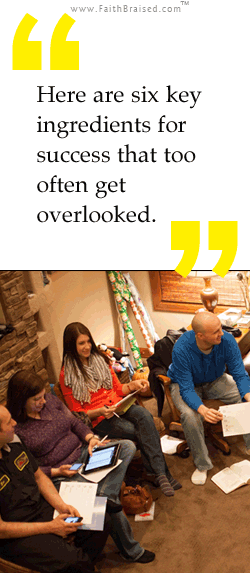
Here are six key ingredients for success that too often get overlooked:

1. Is there an echo in here? Years ago, I read Em Griffin’s great book, Getting Together: A guide for good groups (IVP). One piece of advice always stuck with me. He writes, “Meet in a room small enough to put you in touch with each other. Bank lobbies and church fellowship halls may be impressive, but the cavernous space they allow kills intimacy.”

I’ve tested this by holding meetings in very big and much smaller rooms. The differences are significant. Putting a little group in a large room makes people feel small and lost. Minds and eyes wander as every sight and sound is a distraction. A large group in a too small room is just annoying. Fit your group into an appropriate space; big enough that no one feels cramped, but small enough that it feels cozy and safe.

2. Lukewarm is okay. Thermostat battles are real! While it’s impossible to please everyone perfectly, be aware of the room temperature. An empty room that’s a little cool is a good thing -- don’t bump the heat up! The room will warm on its own when bodies arrive. Pay attention to such things as sleeves being rolled up or down, booklets being used as fans, sweaters being pulled on or off, etc. Ask people if they’re comfortable. Make adjustments gradually to avoid wide temperature swings.

3. The lay of the land. Whether you’re meeting in the church or someone’s home, let everyone know where things are, especially the bathrooms. Explain that bringing a cup of coffee to their seats is okay. Allow time for introductions. If you’re located near a quarry (as a group I participated in was) and there will be a loud explosion or two, let people know what’s going to happen so they won’t panic or become preoccupied wondering if they should.

4. Arranged for success. Yes, how you arrange the chairs makes a difference. The circle is most common. If you’re using a video, then a u-shaped arrangement allowing easy  viewing is okay. However you arrange the seating, make sure everyone can see and hear each other easily. Better Bible engagement comes through better sharing.

5. Just say no to technology. Technology is amazing, but can also be annoying. While using PowerPoint is helpful in the college classroom or sanctuary, it’s seldom useful for a small group. Dimming lights induces dozing when it’s cozy! If you choose to use a video or any technology, make sure you know how to use it. Set everything up before people arrive. Test, test, test. And if there are any glitches, be prepared to set the technology aside and go analog, just like Jesus did.

6. The reason I’ve called you together. Small groups are great for building Bible engagement and relationships. Except when the group’s purpose becomes diffused and ambiguous. Have a purpose, mission, and a goal and make sure everything the group does drives toward them. Ambiguity and loss of focus -- which happens over time with inattention -- will kill the best of groups.

Griffin states, “The good group has cohesiveness.” People know what to expect and where they fit. This doesn’t happen by accident. It takes intentionality and effort. The payoff is the good relationships and better Bible engagement that ensues.

=======

Coming next in part 2: Leading the good group.

Coming next in part 3: Outreach of the good group.

=======

BlogQuestion.pngAre you in a good small group or any group? What makes it a good group or a not so good group? Do you have other good ideas for creating good small groups? Please share them in the comments!

Read more…

Silencing the Cicadas

A few months ago, the Holy Spirit spoke a concise but powerful word to my heart during a personal retreat: “Jim, you need to silence the cicadas!”

If you’ve never been around any cicadas, you may want to visit YouTube and check them out. Cicadas are large, ugly insects that cluster together in trees to make an almost-deafening sound, especially at night.

The Lord advises us in Psalm 46:10, “Be still, and know that I am God.” But how do you do that when you’re surrounded by cicadas?

The cicadas can take a variety of forms today:

  • Our constant connectivity to our phones, emails, and social media.
  • The 24-hour news cycle, which seems to spew out a large percentage of “fake news,” slanted toward the political bias of the network.
  • A society where political correctness is on the rise, while personal analysis and investigation is quickly waning.

Although these surrounding noises are increasingly prevalent, the worst cicadas of all come from our own emotional baggage. It’s one thing to disconnect from societal noise from time to time in order to preserve our sanity. But what about the internal noises that so often threaten our peace and serenity?

Perhaps you’ve never thought of your internal noise as cicadas, but here are some examples:

  • Fears that arise to drown out your faith and your ability to take risks.
  • Anxiety that drowns out your enjoyment of today and your confidence in a happy future.
  • Unforgivenss or bitterness that distorts how you see the people around you.  

The next time you see me, I encourage you to ask me how things are going in silencing the cicadas in my life. Well, let’s just say it’s an ongoing process at this point…

Before you get too wrapped up in putting together your resolutions and goals for the coming year, you may want to take some time to quiet your heart. Dealing with the pesky cicadas—both externally and internally—is the best way to prepare for a great new year ahead!

Read more…

Ready for an Honest New Year's Assessment?

These 5 connections hold the key to spiritual fruitfulness & fulfillment.

A pivotal moment in my life occurred around this time of year in 2010. My friend Don Wright and I were taking our usual walk around the track of Weddington High School, and I told him quite earnestly, “Don, some things have really got to change in my life next year.”

Don has a way of getting to the heart of a matter, and he reminded me of a sobering truth: “I think you said the same thing last year at this time, Jim!”

How terrible it was to see that many areas of my life had become STUCK. Year after year, I had complained. I vowed that things would be different in the coming months and year. Yet nothing really changed.

I hope you have a friend like Don Wright—someone able to provide a mirror to your life and hold you accountable to making the necessary changes to get unstuck. Otherwise, I have bad news: Your New Year’s resolutions are unlikely to bear much fruit.

But what if you’re not even sure about what’s wrong with your current life? Maybe you’re feeling apathetic and dissatisfied, yet you don’t know where to start in diagnosing the problem or making any changes.

After years of studying what the Bible says about having an abundant and impactful life, I’ve concluded that these 5 areas hold the key:

CONNECTION TO GOD: Before you worry about any other changes in your life, this should be the starting place. Without a vital connection with the Lord as your “higher power,” your best efforts will surely fall short.

Since I work for a Christian ministry, you might think this area would never be a problem for me. Not true! I’ve discovered that even when you’re surrounded by “ministry,” your connection with God will be anemic unless you spend time cultivating your personal relationship with Him. There must be intentionality and a constant hunger to keep growing in your intimacy with the Lord.

CONNECTION WITH PEOPLE: Unless you’re a hermit, you already have a number of connections with other people. But are they the right people—those helping you become a better “you” so you can fulfill your highest calling in life? Perhaps you need to delete or minimize some relationships in your life, especially any that are toxic, negative, or overly draining.

In my case, although I have great friends, I find myself desiring to spend more time mentoring the next generation of leaders. I also would really value an older mentor in my own life. Once again, changes like these will require some intentionality on my part if they’re ever going to happen.

CONNECTION WITH TRUTH: In the early days of my Christian life, I spent lots of time studying the Bible, which helped provide me with a strong spiritual foundation ever since.
However, I’ve slacked off in recent years. Instead of learning new things, I’ve been relying far too much on my previous studies.

Successful people are nearly always lifetime learners, continually reading, studying, and growing. What are your plans to keep learning and growing in the coming year?

CONNECTION WITH CHARACTER: Knowledge and hard work will only get you so far. Perhaps you need to deal with long-standing issues of character and maturity that have robbed you of joy and hindered your fruitfulness. Has an addiction been undermining your life, or do you need freedom from some negative emotion like fear, anger, or depression?

The Bible has a lot to say about the type of “fruit” coming from our lives (e.g., Matthew 12:33, Galatians 5:19-23, John 15:1-5). A new year is a great time to assess the quality of our fruit and do any pruning that may be necessary.

CONNECTION WITH SERVICE: God put each of us on this earth to make an impact in some way. An ingrown life is inevitably boring and unfulfilling, so it’s crucial to identify our place of service. Ideally, our service should flow from the spiritual gifts and passions the Lord has given us, but sometimes we’ll be called upon just to fill a need we see. As we reach out to bless others, more of God's blessings are released in our own lives as well (Genesis 12:2, Acts 20:35).

I encourage you to assess these 5 areas of your life as you head into the new year. And if you’re in some kind of leadership or management role, you can encourage your team members to grow in these areas too.

HAPPY NEW YEAR!

Read more…

In Carson McCullers’ classic novel, The Member of the Wedding (Mariner Books; Reprint edition), the main character, Frankie (aka F. Jasmine) who is primed for a change in her life, wonders out loud why she can’t just change her name and be new. Her caretaker, Berenice, responds:

Quote2016.gif
“Because things accumulate around your name,” said Berenice. “You have a name and one thing after another happens to you, and you behave in various ways and do things, so that soon the name begins to have a meaning. Things have accumulated around the name. If it is bad and you have a bad reputation, then you just can’t jump out of your name and escape like that. And if it is good and you have a good reputation, then you should be content and satisfied.”


All have sinned

Everyone has a history marred by sinful actions. Some were things done to us. Many, if not most, were things we did to ourselves. They were results of choices that were often poorly thought out.

There are a million ways to sin. And for each sin there are millions of potential consequences.

These real consequences are the scars we bear that, this side of heaven and unlike guilt, no amount of redemption will completely erase.

The little Pentecostal church I grew up in often had visiting evangelists pass through to conduct “revivals.” A favorite story cropped up in many of their sermons. It was meant as a cautionary tale warning us of the indelible consequences of sin. It went something like this.

There was a little boy who loved to hammer nails into wood. His father’s hobby was woodworking so there were always scraps of lumber. These the little boy was free to hammer in all the nails he wanted.

One day, the little boy was in a hammering mood. He had lots of nails but there were no scraps in his father’s workshop. So, he began driving nails into a large lovely piece of wood. He thought only a few wouldn’t be a big deal.

Caught up in his hammering, he lost track of time until he heard the voice of his father cry out, “Son! What are you doing?”

Startled, the little boy stopped hammering. “Dad! I’m sorry! There were no scraps and I only meant to hammer in a few nails! I can pull these out!” exclaimed the son.

“Okay,” said the father, visibly upset. “You pull the nails out and then come in for supper.”

Supper was very quiet that night. The little boy was afraid to say a word. After supper, his father said, “Come on, son. Let’s go out to the workshop.”

There, they stood looking at the wood. The little boy burst into tears. “I’m sorry father! I didn’t mean to! I pulled all of the nails out! Can you forgive me?”

The father looked lovingly at his son, picked him up in his arms, and spoke softly, “Yes, son, I forgive you. But there’s something you need to understand. Look at the wood.”

They both stared at the wood now filled with holes.

“Son,” said the father. “That was a very expensive piece of wood. I bought it to make your mother a special chest for her birthday. Now, the wood is ruined. Even if I fill them with putty, the holes will still be visible. Just like scars.”


A new name

When we come to Christ, confess our sins, and repent, we are promised a new name in heaven and to be washed white as snow. Both of these are true. As Christians, our names are indelibly written in the Book of Life and God sees us, thanks to the imputed righteousness of Jesus, as clean. Holy without holes!

But here and now, on this earth in this life, it’s not quite the same, as McCullers’ character Frankie was learning. When we’re a stinker, the smell often lingers. Especially when our stinkering involves others who have that annoying habit of remembering. With some, it seems like every time they see us they point, hold their noses, and cry out, “Foul! Foul!”

I know this is true because there are people who have hurt me that only have to come to mind for some reason and my heart cringes. I remember the pain, the betrayal, the lie, or whatever the foul behavior was that caused a rift. Fully forgiving is hard.

I think this is why Jesus counsels us to forgive “seventy times seven.” It’s not that the person isn’t forgiven the first time, but rather that our own hurt needs to be healed and rehealed. Our forgiving them again and again brings healing to our own hurt hearts.

Probably it should also spark in our understanding the truth that others who have been hurt by us go though the same process.

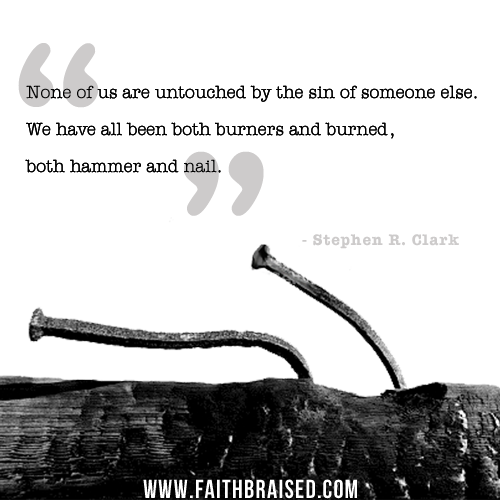
None of us are untouched by the sin of someone else. We have all been both burners and burned, both hammer and nail.

Covering the holes

Sadly, I feel more holey than holy most of the time. I’m sure I’m not alone in this.

The scars -- or holes -- we bear are to serve as reminders, not accusations. It’s not about piling on guilt, on ourselves or anyone else. We must not be about ruining reputations, or getting even, or cowering in shame.

Instead of pointing at each other’s holes, we need to help fill and cover them. Instead of judgment, the borne scars need to draw out from us love, grace, and acceptance.

Toward those who have hurt us, recognizing our own capacity for wounding, we must go easy. Forgive, and when we are unable to forget, extend even more grace. And as we do unto others, we must do to ourselves.

This is not easy. It’s hard. But it’s the love that’s required.

This is not love made of emotion that we grunt and strain out of ourselves. This is true love fired by the Holy Spirit that is reflective of our True Love, Jesus. It’s love that loves even when it doesn’t feel like loving. It’s an expansive and wide love that speaks to the broadness and bigness of our God.

Recovering reputations

None who are repentant should feel the need to change their names to get away from who they’ve been or are. Instead, we must help each other move toward what we each are to become, what we are designed to be. To help the old in all of us become new.

In Frederick Buechner’s novel, Godric (Harper & Row) the main character asks, “What’s friendship, when all’s done, but the giving and taking of wounds?” This brings to mind a well-known verse about how we are often iron sharpening iron (Proverbs 27:17).

Even when our intentions are good, we hurt one another, especially those closest to us. This is the nature of sin in us. It will come out one way or another. We are all well-barbed and susceptible to one another’s barbs.

But the Godric quote can also be taken differently. We can bear the burdens of others by taking on their wounds. By standing with them in their pain and embarrassment of failure or folly, rejection or ridicule -- whatever the misfortune was or is -- and shore them up. Just as we hope others will do with and for us.

Love, not judgment

The scars we bear do not have to be badges of dishonor. If we are children of the Most High God, they should not be. They must not be. Especially when confession, repentance, and renewal are involved.

Likewise, we must not be giving out scarlet letters to all those we know who have sinned and come short of the glory of God just like us. Discernment may be ours, but judgment is not.

When the Holy Spirit opens our eyes to discern the pain in the hearts of another, our only response as Christians is to love, to forgive, to embrace, to stand alongside.

There will be holes. There will be scars. But godly love covers a multitude.


=======
BlogQuestion.pngSee Proverbs 10:12, Proverbs 17:9, and 1 Peter 4:8. Do you feel mostly holy or mostly holey? Why? Are there things you’ve done that you regret? How have you dealt with these? Are there times when instead of accusation, others stood with you? When you stood with others? Share your thoughts and experiences in the comments.

burned500.png
Read more…

Why Heaven Visited Earth

9570806672?profile=original

The Son of Man came to seek and to save the lost.

LUKE 19:10 MLB


I could have saved Myself a lot of trouble, if I had stayed by My Father’s side; instead, I made Myself nothing, donned the garb of a slave, and died a criminal’s death on a Roman cross. Skull Hill was a long way from glory. I went to hell so you would not have to. I became a servant so you could avoid self-destructiveness. I was crucified so you could be changed for the better. I was deserted so you could enjoy the pleasure of My company. I became the Son of Man so you could become a child of God. I died in your place so you could live in Mine. I came to the world not just to challenge you to seek higher goals—I came to offer you My forgiveness and mercy and grace.


I could have saved Myself from physical death had I descended the cross; instead, I saved believers from spiritual death by staying on the cross. I condescended to save you from sin’s penalty, power, and presence. Heartfelt faith in the Savior and public confession of allegiance to Me sets you on the road to heaven. If you have taken this first step of trust in Me, you are free of guilt—no longer on death row, no more condemned to torment! When your old life of sin is buried with Christ, you live a new, free life. One day you will be like Me—this is My dream and your destiny. Salvation is a process I began in your heart—I intend to complete it.


I did not leave heaven to seek smug legalists and self-righteous snobs—but sinners who are painfully aware of their moral failure. If I had saved Myself from humiliation, you could not be saved from hell. My heart goes out to all people—I died for the sins of the entire world. Religionists who think they are good enough have no interest in Me. Humble souls understand My purpose—smart-alecks are clueless.


Glory will fill your soul when you know why heaven visited earth.


Johnny R. Almond

Pastor, Hull’s Memorial Baptist Church - Friends on a Journey of Faith

Author, Gentle Whispers from Eternity—book available on Amazon

http://GentleWhispersFromEternity--ScripturePersonalized.com/

This devotional based on day 318 of Gentle Whispers from Eternity


Read more…

Why Heaven Visited Earth

9570806672?profile=original

The Son of Man came to seek and to save the lost.

LUKE 19:10 MLB


I could have saved Myself a lot of trouble, if I had stayed by My Father’s side; instead, I made Myself nothing, donned the garb of a slave, and died a criminal’s death on a Roman cross. Skull Hill was a long way from glory. I went to hell so you would not have to. I became a servant so you could avoid self-destructiveness. I was crucified so you could be changed for the better. I was deserted so you could enjoy the pleasure of My company. I became the Son of Man so you could become a child of God. I died in your place so you could live in Mine. I came to the world not just to challenge you to seek higher goals—I came to offer you My forgiveness and mercy and grace.


I could have saved Myself from physical death had I descended the cross; instead, I saved believers from spiritual death by staying on the cross. I condescended to save you from sin’s penalty, power, and presence. Heartfelt faith in the Savior and public confession of allegiance to Me sets you on the road to heaven. If you have taken this first step of trust in Me, you are free of guilt—no longer on death row, no more condemned to torment! When your old life of sin is buried with Christ, you live a new, free life. One day you will be like Me—this is My dream and your destiny. Salvation is a process I began in your heart—I intend to complete it.


I did not leave heaven to seek smug legalists and self-righteous snobs—but sinners who are painfully aware of their moral failure. If I had saved Myself from humiliation, you could not be saved from hell. My heart goes out to all people—I died for the sins of the entire world. Religionists who think they are good enough have no interest in Me. Humble souls understand My purpose—smart-alecks are clueless.


Glory will fill your soul when you know why heaven visited earth.


Johnny R. Almond

Pastor, Hull’s Memorial Baptist Church - Friends on a Journey of Faith

Author, Gentle Whispers from Eternity—book available on Amazon

http://GentleWhispersFromEternity--ScripturePersonalized.com/

This devotional based on day 318 of Gentle Whispers from Eternity


Read more…